
Development
How to Build a Personality Quiz App
A personality quiz app asks users a few short questions and delivers a personalized result worth sharing. This guide covers the features, development timeline, and cost of building one.
The result people cannot resist sharing
A personality quiz app lives or dies on one moment, the instant someone sees their result and decides whether it is worth showing a friend. Everything else in the product exists to make that moment happen often and happen fast. This guide covers the architecture, cost, and timeline behind building one that people actually keep opening.
What a Personality Quiz App Actually Does
A personality quiz app leads a user through a short set of questions, then delivers a personalized result meant to feel accurate and worth sharing. The format is genuinely effective. Personality quizzes average about two minutes and forty eight seconds per session with a completion rate near 73 percent, according to a 2026 industry report on online personality testing. That same report found quiz style content draws roughly three times the engagement of a standard article. That format advantage is exactly what a native quiz app is built to capture, rather than borrowing the format from a website. The app itself mainly handles the quiz flow and the result card that comes out the other end. It also handles surfacing new quizzes often enough that a user has a reason to come back beyond the one they just finished. None of this requires deep technical complexity. It requires making the result feel personal enough that sharing it feels like self expression rather than clicking through an ad.
Three Formats a Quiz App Can Take
Not every quiz app is trying to create the same kind of moment, and three formats cover most of what gets built.
Format | Best for | Tradeoff |
Quick single result quiz | High frequency use and social sharing driven growth | Any one quiz is shallow, so the app depends on a steady stream of fresh ones |
Cumulative multi quiz profile | Users who want an evolving picture of themselves over time | Needs a more complex data model to store and reference past results |
Long form single assessment | Users seeking one thorough, serious result | Higher drop off risk, since it asks for real time investment before any payoff |
Mygen sits in the first row, built around quizzes that take a few taps and end in a result worth sharing immediately. That format was a deliberate choice, not a smaller version of a deeper personality platform. It optimizes for a completely different thing, frequency and shareability, over depth.
Choosing the format changes what actually gets built:
Choose a quick single result quiz when growth depends on sharing, and design the result card itself as a core feature worth real design attention, not an afterthought screen
Choose a cumulative profile when the goal is a long term relationship with one evolving result, and expect the data model and history screens to add real scope
Choose a long form assessment only when the audience genuinely wants a thorough result over speed, since asking for that much upfront time trades reach for depth
Most teams assume more quiz depth automatically means more value to the user. In this category, the opposite is often true. Depth without shareability just means fewer people ever see the result at all.
How to Scope the First Version
Most quiz apps fail on the two things that decide whether anyone opens the app twice, not on the number of quizzes available at launch. A first version with a handful of genuinely good quizzes and a shareable result card beats one with a large library and a forgettable ending.
Design the result card as carefully as the quiz itself, the way Mygen's results ship as a visual card built for saving or sharing on social platforms
Build a content refresh rhythm into the plan from day one, since Mygen's home screen highlights new quizzes regularly rather than relying on a fixed library to hold attention
Let users revisit past results and explore new ones over time, since that history is what turns a single fun moment into a habit worth returning to
Teams that launch with dozens of quizzes and a plain, unshareable result screen usually discover the quiz count never mattered much at all. The card people actually want to post to their own profile is what decides whether the app spreads beyond the person who first opened it.
What a Realistic Build Timeline Looks Like
Mygen shipped in two months, and four stages made up that window.
Discovery and scope, where the team locks the quiz flow, the result card design, and the content refresh rhythm before any single quiz gets built
Core build, the largest block on the calendar, where the quiz flow, result generation, and sharing mechanics come together against that locked scope
Content and sharing testing, run with real quiz content and real social platform previews, not a single placeholder quiz shared only inside the team
Launch and monitor, the first few weeks live, when real sharing behavior tests whether results actually travel beyond the person who took the quiz
Skipping real sharing tests is the most common reason a result card that looked great in design shows up broken or unappealing once it actually lands in a social feed.

What Moves the Budget and Timeline
These factors move the budget on a quiz app more than anything else in the brief:
Result card design depth, since a shareable card that looks genuinely good takes real design iteration, not just a template with a name swapped in
Content creation pipeline, since a steady supply of new, well written quizzes is an ongoing production need separate from building the app that delivers them
Sharing and virality mechanics, since consumer apps built around organic sharing generally target a viral coefficient of about 0.15 to 0.4 to meaningfully compound growth, per 2026 growth benchmarks
Personalization logic, since a result that feels generic undermines the exact shareability the whole format depends on
That viral coefficient number matters more than it looks like it should. A coefficient near 0.4 means a meaningful share of new users arrive because someone else shared a result, not because of paid acquisition. Reaching even that modest number depends entirely on the result card being something a person actually wants attached to their name. That is a design and product decision, not a marketing afterthought bolted on after launch.
A focused mobile app with a quiz flow, result generation, and sharing built in typically runs from about 15,000 to 40,000 dollars for an MVP scope, according to 2026 industry pricing guides. Cost rises quickly once a cumulative profile system or a large content team gets added.
What This Costs Beyond the Build Fee
The build fee covers the app. Keeping it worth opening depends on ongoing costs that are easy to underweight during planning.
Ongoing content creation, since new quizzes need to keep appearing on a real schedule, and that writing and design work never stops the way a one time build fee does
Image and card generation infrastructure, for producing a fresh, personalized visual result card reliably at whatever volume the quiz flow attracts
Light backend hosting, for storing quiz content and any history of past results a user can revisit
Social platform preview maintenance, since sharing platforms periodically change how they render shared links, and a broken preview quietly kills the exact sharing loop the app depends on
The content pipeline is the cost most first time teams underestimate. An app can have a flawless quiz flow and still stall out within weeks if nothing new appears for a returning user to try.

Where These Apps Break in Production
The quiz flow itself is rarely the problem. What happens after someone finishes is where things go wrong.
Stale content, since a quiz library that stops growing loses the daily habit fastest in exactly this category, where novelty is most of the appeal
Broken share previews, since a result card that renders perfectly in the app but shows up blank or wrong on a social platform loses the entire point of building it shareable
Generic feeling results, since a personalization system that produces the same handful of outcomes for everyone quietly erodes the sense that a result is worth sharing at all
Monetization that interrupts the moment, since gating a result behind an ad or a paywall right when someone wants to share it fights against the app's own growth mechanic
Traffic spikes from a single quiz going wider than expected, since a genuinely shareable result can pull in far more visitors in a single day than steady, predictable growth ever would
None of this shows up in a demo where a team member takes one quiz and admires the result on their own phone. It shows up once real users share real results into real feeds, on platforms that render link previews differently and change those rules without warning. A quiz that works perfectly in a walkthrough can still fail completely at the one job that actually matters for this category.
The Quiz App We Have Shipped
Neon Apps built Mygen around exactly this quick, shareable quiz model.
Project | Client | Year | Build time | What it solved |
Onedio | 2025 | 2 months | Short personality quizzes with shareable, personalized result cards |
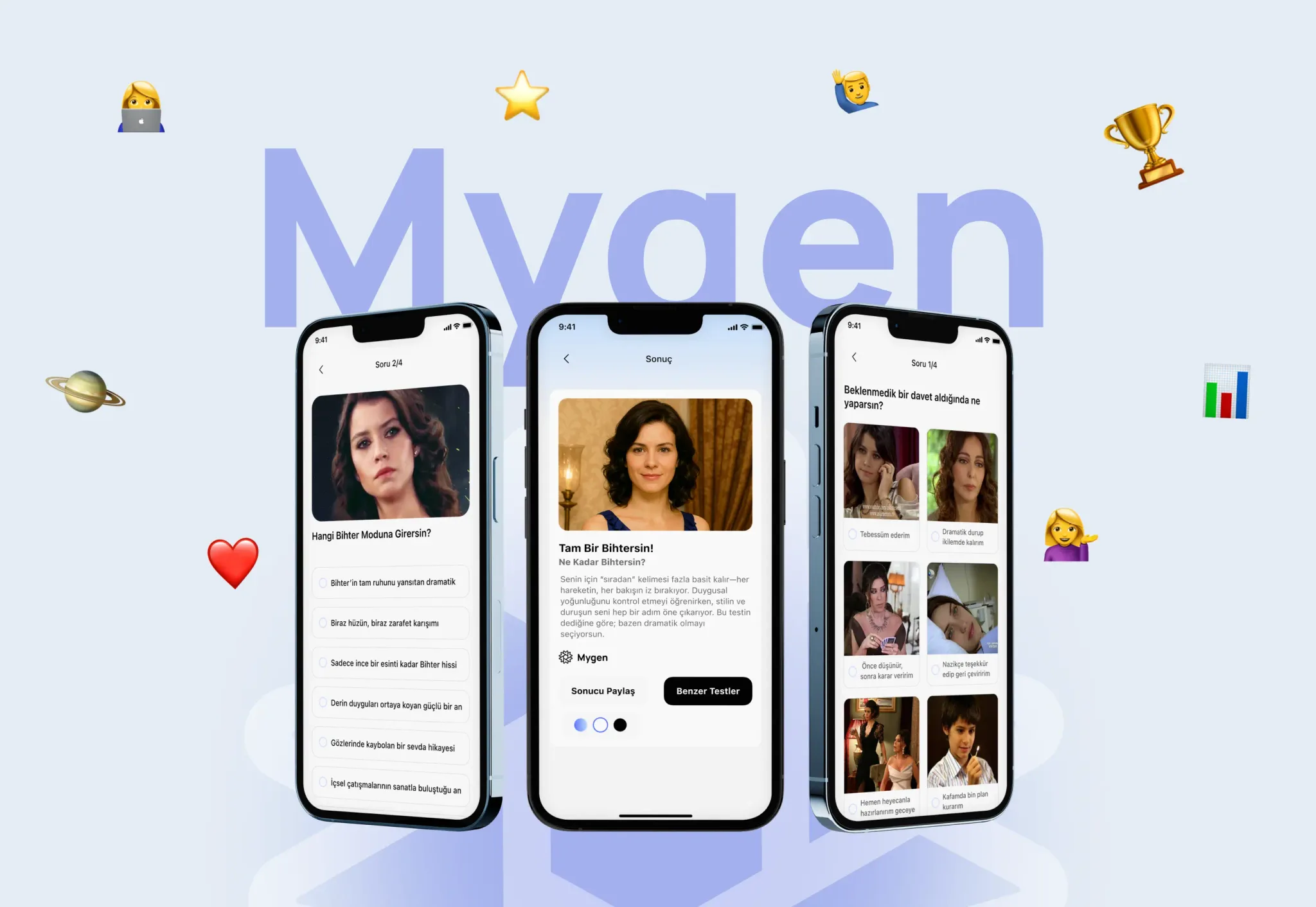
Mygen lets users learn something about themselves through short, culture and personality themed quizzes that work in a few taps. Each quiz ends in a personalized result card designed for saving or sharing on social platforms, with a short explanation that makes the result feel earned rather than random. The home screen highlights new quizzes regularly, so there is always something fresh to try without the library ever feeling overwhelming. Users can revisit past results and take new quizzes daily, exploring different sides of themselves over repeated sessions. The shareable results encouraged return visits and consistent engagement, and Mygen continues to grow as a light, meaningful entertainment experience. Planning app growth and monetization consulting around what actually gets a result shared, rather than around quiz count alone, is what turned a two month build into a habit people kept returning to.
related projects
FAQ
What is a personality quiz app?
What does Neon Apps bring to a quiz app project?
Should a quiz app focus on one quiz format or several?
How does Neon Apps scope a quiz app project?
How long and how much does a personality quiz app cost to build?
Stay Inspired
Get fresh design insights, articles, and resources delivered straight to your inbox.
Get stories, insights, and updates from the Neon Apps team straight to your inbox.
Latest Blogs
Stay Inspired
Get stories, insights, and updates from the Neon Apps team straight to your inbox.
Got a project?
Let's Connect
Got a project? We build world-class mobile and web apps for startups and global brands.
Neon Apps is a product development company building mobile, web, and SaaS products with an 85-member in-house team in Istanbul and New York, delivering scalable products as a long-term development partner.
Industries
Primary Services
Delivery & Product Services
Supporting Services

Development
How to Build a Personality Quiz App
A personality quiz app asks users a few short questions and delivers a personalized result worth sharing. This guide covers the features, development timeline, and cost of building one.
The result people cannot resist sharing
A personality quiz app lives or dies on one moment, the instant someone sees their result and decides whether it is worth showing a friend. Everything else in the product exists to make that moment happen often and happen fast. This guide covers the architecture, cost, and timeline behind building one that people actually keep opening.
What a Personality Quiz App Actually Does
A personality quiz app leads a user through a short set of questions, then delivers a personalized result meant to feel accurate and worth sharing. The format is genuinely effective. Personality quizzes average about two minutes and forty eight seconds per session with a completion rate near 73 percent, according to a 2026 industry report on online personality testing. That same report found quiz style content draws roughly three times the engagement of a standard article. That format advantage is exactly what a native quiz app is built to capture, rather than borrowing the format from a website. The app itself mainly handles the quiz flow and the result card that comes out the other end. It also handles surfacing new quizzes often enough that a user has a reason to come back beyond the one they just finished. None of this requires deep technical complexity. It requires making the result feel personal enough that sharing it feels like self expression rather than clicking through an ad.

Three Formats a Quiz App Can Take
Not every quiz app is trying to create the same kind of moment, and three formats cover most of what gets built.
Format | Best for | Tradeoff |
Quick single result quiz | High frequency use and social sharing driven growth | Any one quiz is shallow, so the app depends on a steady stream of fresh ones |
Cumulative multi quiz profile | Users who want an evolving picture of themselves over time | Needs a more complex data model to store and reference past results |
Long form single assessment | Users seeking one thorough, serious result | Higher drop off risk, since it asks for real time investment before any payoff |
Mygen sits in the first row, built around quizzes that take a few taps and end in a result worth sharing immediately. That format was a deliberate choice, not a smaller version of a deeper personality platform. It optimizes for a completely different thing, frequency and shareability, over depth.
Choosing the format changes what actually gets built:
Choose a quick single result quiz when growth depends on sharing, and design the result card itself as a core feature worth real design attention, not an afterthought screen
Choose a cumulative profile when the goal is a long term relationship with one evolving result, and expect the data model and history screens to add real scope
Choose a long form assessment only when the audience genuinely wants a thorough result over speed, since asking for that much upfront time trades reach for depth
Most teams assume more quiz depth automatically means more value to the user. In this category, the opposite is often true. Depth without shareability just means fewer people ever see the result at all.
How to Scope the First Version
Most quiz apps fail on the two things that decide whether anyone opens the app twice, not on the number of quizzes available at launch. A first version with a handful of genuinely good quizzes and a shareable result card beats one with a large library and a forgettable ending.
Design the result card as carefully as the quiz itself, the way Mygen's results ship as a visual card built for saving or sharing on social platforms
Build a content refresh rhythm into the plan from day one, since Mygen's home screen highlights new quizzes regularly rather than relying on a fixed library to hold attention
Let users revisit past results and explore new ones over time, since that history is what turns a single fun moment into a habit worth returning to
Teams that launch with dozens of quizzes and a plain, unshareable result screen usually discover the quiz count never mattered much at all. The card people actually want to post to their own profile is what decides whether the app spreads beyond the person who first opened it.
What a Realistic Build Timeline Looks Like
Mygen shipped in two months, and four stages made up that window.
Discovery and scope, where the team locks the quiz flow, the result card design, and the content refresh rhythm before any single quiz gets built
Core build, the largest block on the calendar, where the quiz flow, result generation, and sharing mechanics come together against that locked scope
Content and sharing testing, run with real quiz content and real social platform previews, not a single placeholder quiz shared only inside the team
Launch and monitor, the first few weeks live, when real sharing behavior tests whether results actually travel beyond the person who took the quiz
Skipping real sharing tests is the most common reason a result card that looked great in design shows up broken or unappealing once it actually lands in a social feed.


What Moves the Budget and Timeline
These factors move the budget on a quiz app more than anything else in the brief:
Result card design depth, since a shareable card that looks genuinely good takes real design iteration, not just a template with a name swapped in
Content creation pipeline, since a steady supply of new, well written quizzes is an ongoing production need separate from building the app that delivers them
Sharing and virality mechanics, since consumer apps built around organic sharing generally target a viral coefficient of about 0.15 to 0.4 to meaningfully compound growth, per 2026 growth benchmarks
Personalization logic, since a result that feels generic undermines the exact shareability the whole format depends on
That viral coefficient number matters more than it looks like it should. A coefficient near 0.4 means a meaningful share of new users arrive because someone else shared a result, not because of paid acquisition. Reaching even that modest number depends entirely on the result card being something a person actually wants attached to their name. That is a design and product decision, not a marketing afterthought bolted on after launch.
A focused mobile app with a quiz flow, result generation, and sharing built in typically runs from about 15,000 to 40,000 dollars for an MVP scope, according to 2026 industry pricing guides. Cost rises quickly once a cumulative profile system or a large content team gets added.
What This Costs Beyond the Build Fee
The build fee covers the app. Keeping it worth opening depends on ongoing costs that are easy to underweight during planning.
Ongoing content creation, since new quizzes need to keep appearing on a real schedule, and that writing and design work never stops the way a one time build fee does
Image and card generation infrastructure, for producing a fresh, personalized visual result card reliably at whatever volume the quiz flow attracts
Light backend hosting, for storing quiz content and any history of past results a user can revisit
Social platform preview maintenance, since sharing platforms periodically change how they render shared links, and a broken preview quietly kills the exact sharing loop the app depends on
The content pipeline is the cost most first time teams underestimate. An app can have a flawless quiz flow and still stall out within weeks if nothing new appears for a returning user to try.

Where These Apps Break in Production
The quiz flow itself is rarely the problem. What happens after someone finishes is where things go wrong.
Stale content, since a quiz library that stops growing loses the daily habit fastest in exactly this category, where novelty is most of the appeal
Broken share previews, since a result card that renders perfectly in the app but shows up blank or wrong on a social platform loses the entire point of building it shareable
Generic feeling results, since a personalization system that produces the same handful of outcomes for everyone quietly erodes the sense that a result is worth sharing at all
Monetization that interrupts the moment, since gating a result behind an ad or a paywall right when someone wants to share it fights against the app's own growth mechanic
Traffic spikes from a single quiz going wider than expected, since a genuinely shareable result can pull in far more visitors in a single day than steady, predictable growth ever would
None of this shows up in a demo where a team member takes one quiz and admires the result on their own phone. It shows up once real users share real results into real feeds, on platforms that render link previews differently and change those rules without warning. A quiz that works perfectly in a walkthrough can still fail completely at the one job that actually matters for this category.
The Quiz App We Have Shipped
Neon Apps built Mygen around exactly this quick, shareable quiz model.
Project | Client | Year | Build time | What it solved |
Onedio | 2025 | 2 months | Short personality quizzes with shareable, personalized result cards |
Mygen lets users learn something about themselves through short, culture and personality themed quizzes that work in a few taps. Each quiz ends in a personalized result card designed for saving or sharing on social platforms, with a short explanation that makes the result feel earned rather than random. The home screen highlights new quizzes regularly, so there is always something fresh to try without the library ever feeling overwhelming. Users can revisit past results and take new quizzes daily, exploring different sides of themselves over repeated sessions. The shareable results encouraged return visits and consistent engagement, and Mygen continues to grow as a light, meaningful entertainment experience. Planning app growth and monetization consulting around what actually gets a result shared, rather than around quiz count alone, is what turned a two month build into a habit people kept returning to.
related projects
FAQ
What is a personality quiz app?
What does Neon Apps bring to a quiz app project?
Should a quiz app focus on one quiz format or several?
How does Neon Apps scope a quiz app project?
How long and how much does a personality quiz app cost to build?
Stay Inspired
Get fresh design insights, articles, and resources delivered straight to your inbox.
Get stories, insights, and updates from the Neon Apps team straight to your inbox.
Latest Blogs
Stay Inspired
Get stories, insights, and updates from the Neon Apps team straight to your inbox.
Got a project?
Let's Connect
Got a project? We build world-class mobile and web apps for startups and global brands.
Neon Apps is a product development company building mobile, web, and SaaS products with an 85-member in-house team in Istanbul and New York, delivering scalable products as a long-term development partner.
Industries
Primary Services
Delivery & Product Services
Supporting Services

Development
How to Build a Personality Quiz App
A personality quiz app asks users a few short questions and delivers a personalized result worth sharing. This guide covers the features, development timeline, and cost of building one.
The result people cannot resist sharing
A personality quiz app lives or dies on one moment, the instant someone sees their result and decides whether it is worth showing a friend. Everything else in the product exists to make that moment happen often and happen fast. This guide covers the architecture, cost, and timeline behind building one that people actually keep opening.
What a Personality Quiz App Actually Does
A personality quiz app leads a user through a short set of questions, then delivers a personalized result meant to feel accurate and worth sharing. The format is genuinely effective. Personality quizzes average about two minutes and forty eight seconds per session with a completion rate near 73 percent, according to a 2026 industry report on online personality testing. That same report found quiz style content draws roughly three times the engagement of a standard article. That format advantage is exactly what a native quiz app is built to capture, rather than borrowing the format from a website. The app itself mainly handles the quiz flow and the result card that comes out the other end. It also handles surfacing new quizzes often enough that a user has a reason to come back beyond the one they just finished. None of this requires deep technical complexity. It requires making the result feel personal enough that sharing it feels like self expression rather than clicking through an ad.

Three Formats a Quiz App Can Take
Not every quiz app is trying to create the same kind of moment, and three formats cover most of what gets built.
Format | Best for | Tradeoff |
Quick single result quiz | High frequency use and social sharing driven growth | Any one quiz is shallow, so the app depends on a steady stream of fresh ones |
Cumulative multi quiz profile | Users who want an evolving picture of themselves over time | Needs a more complex data model to store and reference past results |
Long form single assessment | Users seeking one thorough, serious result | Higher drop off risk, since it asks for real time investment before any payoff |
Mygen sits in the first row, built around quizzes that take a few taps and end in a result worth sharing immediately. That format was a deliberate choice, not a smaller version of a deeper personality platform. It optimizes for a completely different thing, frequency and shareability, over depth.
Choosing the format changes what actually gets built:
Choose a quick single result quiz when growth depends on sharing, and design the result card itself as a core feature worth real design attention, not an afterthought screen
Choose a cumulative profile when the goal is a long term relationship with one evolving result, and expect the data model and history screens to add real scope
Choose a long form assessment only when the audience genuinely wants a thorough result over speed, since asking for that much upfront time trades reach for depth
Most teams assume more quiz depth automatically means more value to the user. In this category, the opposite is often true. Depth without shareability just means fewer people ever see the result at all.
How to Scope the First Version
Most quiz apps fail on the two things that decide whether anyone opens the app twice, not on the number of quizzes available at launch. A first version with a handful of genuinely good quizzes and a shareable result card beats one with a large library and a forgettable ending.
Design the result card as carefully as the quiz itself, the way Mygen's results ship as a visual card built for saving or sharing on social platforms
Build a content refresh rhythm into the plan from day one, since Mygen's home screen highlights new quizzes regularly rather than relying on a fixed library to hold attention
Let users revisit past results and explore new ones over time, since that history is what turns a single fun moment into a habit worth returning to
Teams that launch with dozens of quizzes and a plain, unshareable result screen usually discover the quiz count never mattered much at all. The card people actually want to post to their own profile is what decides whether the app spreads beyond the person who first opened it.
What a Realistic Build Timeline Looks Like
Mygen shipped in two months, and four stages made up that window.
Discovery and scope, where the team locks the quiz flow, the result card design, and the content refresh rhythm before any single quiz gets built
Core build, the largest block on the calendar, where the quiz flow, result generation, and sharing mechanics come together against that locked scope
Content and sharing testing, run with real quiz content and real social platform previews, not a single placeholder quiz shared only inside the team
Launch and monitor, the first few weeks live, when real sharing behavior tests whether results actually travel beyond the person who took the quiz
Skipping real sharing tests is the most common reason a result card that looked great in design shows up broken or unappealing once it actually lands in a social feed.


What Moves the Budget and Timeline
These factors move the budget on a quiz app more than anything else in the brief:
Result card design depth, since a shareable card that looks genuinely good takes real design iteration, not just a template with a name swapped in
Content creation pipeline, since a steady supply of new, well written quizzes is an ongoing production need separate from building the app that delivers them
Sharing and virality mechanics, since consumer apps built around organic sharing generally target a viral coefficient of about 0.15 to 0.4 to meaningfully compound growth, per 2026 growth benchmarks
Personalization logic, since a result that feels generic undermines the exact shareability the whole format depends on
That viral coefficient number matters more than it looks like it should. A coefficient near 0.4 means a meaningful share of new users arrive because someone else shared a result, not because of paid acquisition. Reaching even that modest number depends entirely on the result card being something a person actually wants attached to their name. That is a design and product decision, not a marketing afterthought bolted on after launch.
A focused mobile app with a quiz flow, result generation, and sharing built in typically runs from about 15,000 to 40,000 dollars for an MVP scope, according to 2026 industry pricing guides. Cost rises quickly once a cumulative profile system or a large content team gets added.
What This Costs Beyond the Build Fee
The build fee covers the app. Keeping it worth opening depends on ongoing costs that are easy to underweight during planning.
Ongoing content creation, since new quizzes need to keep appearing on a real schedule, and that writing and design work never stops the way a one time build fee does
Image and card generation infrastructure, for producing a fresh, personalized visual result card reliably at whatever volume the quiz flow attracts
Light backend hosting, for storing quiz content and any history of past results a user can revisit
Social platform preview maintenance, since sharing platforms periodically change how they render shared links, and a broken preview quietly kills the exact sharing loop the app depends on
The content pipeline is the cost most first time teams underestimate. An app can have a flawless quiz flow and still stall out within weeks if nothing new appears for a returning user to try.

Where These Apps Break in Production
The quiz flow itself is rarely the problem. What happens after someone finishes is where things go wrong.
Stale content, since a quiz library that stops growing loses the daily habit fastest in exactly this category, where novelty is most of the appeal
Broken share previews, since a result card that renders perfectly in the app but shows up blank or wrong on a social platform loses the entire point of building it shareable
Generic feeling results, since a personalization system that produces the same handful of outcomes for everyone quietly erodes the sense that a result is worth sharing at all
Monetization that interrupts the moment, since gating a result behind an ad or a paywall right when someone wants to share it fights against the app's own growth mechanic
Traffic spikes from a single quiz going wider than expected, since a genuinely shareable result can pull in far more visitors in a single day than steady, predictable growth ever would
None of this shows up in a demo where a team member takes one quiz and admires the result on their own phone. It shows up once real users share real results into real feeds, on platforms that render link previews differently and change those rules without warning. A quiz that works perfectly in a walkthrough can still fail completely at the one job that actually matters for this category.
The Quiz App We Have Shipped
Neon Apps built Mygen around exactly this quick, shareable quiz model.
Project | Client | Year | Build time | What it solved |
Onedio | 2025 | 2 months | Short personality quizzes with shareable, personalized result cards |
Mygen lets users learn something about themselves through short, culture and personality themed quizzes that work in a few taps. Each quiz ends in a personalized result card designed for saving or sharing on social platforms, with a short explanation that makes the result feel earned rather than random. The home screen highlights new quizzes regularly, so there is always something fresh to try without the library ever feeling overwhelming. Users can revisit past results and take new quizzes daily, exploring different sides of themselves over repeated sessions. The shareable results encouraged return visits and consistent engagement, and Mygen continues to grow as a light, meaningful entertainment experience. Planning app growth and monetization consulting around what actually gets a result shared, rather than around quiz count alone, is what turned a two month build into a habit people kept returning to.

related projects
FAQ
What is a personality quiz app?
What does Neon Apps bring to a quiz app project?
Should a quiz app focus on one quiz format or several?
How does Neon Apps scope a quiz app project?
How long and how much does a personality quiz app cost to build?
Stay Inspired
Get fresh design insights, articles, and resources delivered straight to your inbox.
Get stories, insights, and updates from the Neon Apps team straight to your inbox.
Latest Blogs
Stay Inspired
Get stories, insights, and updates from the Neon Apps team straight to your inbox.
Got a project?
Let's Connect
Got a project? We build world-class mobile and web apps for startups and global brands.
Neon Apps is a product development company building mobile, web, and SaaS products with an 85-member in-house team in Istanbul and New York, delivering scalable products as a long-term development partner.
Industries
Primary Services
Delivery & Product Services
Supporting Services