
Business Development & Marketing SpecialistSeptember 8, 2026
The question a confidence score cannot dodge
Every AI identifier app eventually has to decide what to show a user when the model is not sure. This guide covers the architecture, cost, and timeline behind building one, and the confidence problem that sits underneath all of it.
What an AI Image Identifier App Actually Does
An AI image identifier app takes a photo and returns what the model thinks it is looking at. That might be a plant species, a coin, or a product a user wants to buy. The global image recognition market was valued at 58.56 billion dollars in 2025 and is projected to reach 68.46 billion dollars in 2026, according to Fortune Business Insights. The app itself mainly handles the camera flow, sends the photo to a classification model, and presents the result with enough context that a user trusts or questions it appropriately. None of this requires building or training a computer vision model from scratch. It requires picking the right managed provider, designing a camera flow that captures a usable photo, and being honest with users about how confident the result actually is.

The Three Ways to Power Identification
Not every identifier app answers the same kind of question, and the architecture has to match the question being asked.
Approach | Best for | Tradeoff |
Managed classification API | Identifying species or types from a fixed category set | Only as accurate as the categories it was trained on |
Visual similarity matching | Finding a specific product in a retailer catalog | Needs a live, well tagged catalog to match against |
On device inference | Offline identification, privacy sensitive photos | Smaller models, generally lower accuracy |
Plant Identifier and Coin Identifier both answer a classification question: which known category does this photo belong to. Blushy answers a different question entirely, matching a photo against a retailer's product catalog to find something a user can actually buy. That result depends on catalog quality as much as on the model itself. On device inference through Core ML or ML Kit exists and works for narrower tasks, but Neon Apps has not shipped this approach. Published guidance from Apple and Google suggests it earns its complexity mainly when a product cannot depend on network access at all.
Matching the architecture to the question matters more than picking the most impressive sounding model:
Choose a managed classification API when the app identifies something from a bounded, well documented category set, such as plants, coins, or common objects
Choose visual similarity matching when the goal is finding a specific item in a catalog rather than naming a category, since the two problems need different underlying systems
Choose on device inference only when offline use or strict privacy is a hard requirement, since it trades real accuracy for that guarantee
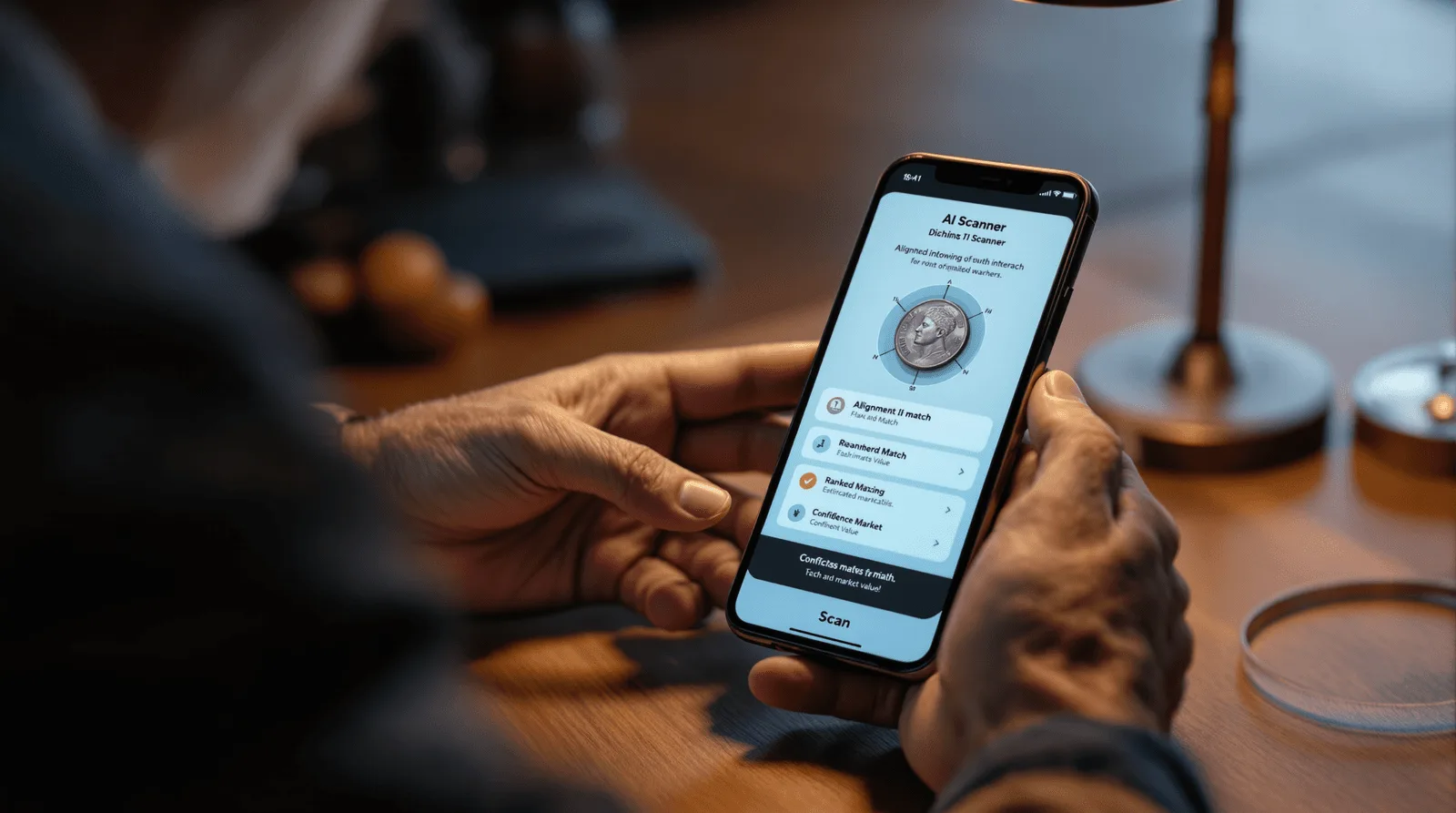
Confidence display is a fourth decision that sits on top of all three architectures. A single score is easy to build but easy to misread, since most users have no real baseline for what any given match percentage actually means. Showing two or three ranked alternatives, the way Coin Identifier does, gives users something closer to a real decision than a single number ever could.
How to Scope the First Version
Most identifier apps fail on category breadth, not on model quality. A narrow first version proves the core loop before the category list grows past what a single model can handle well.
Pick one category domain and describe its edge cases before writing a line of code, since "plants" and "venomous plants specifically" are very different scoping decisions
Decide what happens below a confidence threshold, since showing a wrong answer with total confidence is worse than showing an honest "not sure, here are the closest matches"
Design the capture guidance before the recognition call, since Coin Identifier's lighting and framing tips before the scan improve the input more than any model tuning could afterward
Teams that launch trying to identify everything in a broad category usually narrow the scope after launch anyway. Real world photos expose categories the model was never actually trained to handle well.
What a Realistic Build Timeline Looks Like
Shipped examples in this category range from six weeks to two months, among the fastest categories Neon Apps builds in, and four stages make up that window.
Discovery and scope, where the team locks the category set, the confidence threshold behavior, and the capture flow before any screen gets designed
Core build, the largest block on the calendar, where the camera flow, the classification call, and the result screen come together against that locked scope
Accuracy testing against real world photos, not clean reference images, since lighting, angle, and background vary far more outside a test lab
Launch and monitor, the first few weeks live, when real user photos reveal categories and conditions the training data underrepresented
Skipping real world accuracy testing is the most common reason a model that looked excellent on clean sample photos performs noticeably worse once real users start scanning. Blurry photos, harsh shadows, and cluttered backgrounds are the norm outside a demo, not the exception.
Four Things That Move the Budget and Timeline
These four factors move the budget on an identifier app more than anything else in the brief:
Category breadth, since Coin Identifier's narrower scope shipped in six weeks while Plant Identifier's broader category set took two months
Confidence UI depth, since showing ranked alternatives with confidence labels, the way Coin Identifier does, takes more design and testing than a single yes or no answer
Post identification features, since care reminders, value lookups, or shopping links each add their own scope on top of the identification call itself
Catalog dependency, since a visual matching app like Blushy needs an ongoing content pipeline to keep the product catalog fresh, not just a one time integration
Neon Apps shipped Coin Identifier in about six weeks on a tightly scoped category set. Plant Identifier took two months, adding a health check feature and care reminders on top of the base identification loop.
What This Costs Beyond the Build Fee
The build fee covers the app. Every scan afterward carries its own cost, priced by the provider per image or per thousand images.
Managed classification API fees, which run from about 0.1 to 0.3 cents per image on AWS Rekognition's standard tier, up to 1.50 dollars per thousand units on Google Cloud Vision depending on the feature used
Catalog infrastructure for visual matching apps, since Blushy's approach needs a searchable index of retailer products kept current, which is an ongoing cost separate from the recognition call itself
Manual review or escalation paths for low confidence results, since some fraction of scans will need a fallback beyond the automated answer
A free tier that looks affordable at a thousand scans a month can become a real line item once an app is identifying tens of thousands of photos. That is why usage limits need to be modeled against scans, not against downloads.

Where These Apps Break in Production
The classification model rarely fails loudly. It fails quietly, by sounding confident about the wrong answer.
Confident wrong answers, since a model that states a category with high confidence gives users no reason to double check it, which matters most when the category has real consequences
Training and reality mismatch, since a model trained mostly on clean reference photos underperforms on the blurry, poorly lit, oddly angled photos real users actually take
Catalog drift, since a visual matching app's results go stale the moment the underlying retailer catalog changes faster than the matching index updates
Capture quality variance, since skipping the lighting and framing guidance that Coin Identifier builds in leads to more bad photos and more wrong results downstream
Category creep, since every "can it also identify this" request quietly expands the training and testing surface long after the original scope was signed off
None of this shows up in a demo run on hand picked sample photos. It shows up once real users scan real, imperfect photos in real lighting. That is why honest confidence communication belongs in the design from the start, not as a patch after the first wrong answer complaint. Safety relevant categories, such as identifying whether a plant is toxic, need extra care. The interface should frame the result as a starting point for verification, not a final answer. Anything with real consequences deserves a pointer toward an expert source, not just a confidence score.
AI Identifier Apps We Have Shipped
Neon Apps has built three identifier apps, each answering a different kind of identification question.
Project | Client | Year | Build time | What it solved |
Madduck | 2024 | 2 months | Identifies plants from photos with care tips and a health check | |
Titano | 2024 | 1.5 months | Identifies coins with confidence labels and value ranges | |
Blushy Technologies | 2023 | 2 years, ongoing | Matches outfit photos to real, purchasable products |
Plant Identifier and Coin Identifier both classify against a fixed category set, but built different depth on top of it. Plant Identifier added a health check that reviews symptoms and suggests possible issues, plus reminders that keep users returning to the app between scans. Coin Identifier invested earlier in the flow, guiding users on lighting and framing before the scan even happens. It then shows ranked matches with confidence labels and a value range pulled from recent market data. Blushy solved a fundamentally different problem. Instead of naming a category, it scans an outfit photo, detects individual clothing items, and finds identical or similar products from real retailers a user can actually buy. That shift from classification to matching is why Blushy has stayed in active development for two years, adding Android support and better product matching well after its first release. The two classification apps, by contrast, shipped and stabilized in a matter of weeks. Planning MVP development around one identification question first is what let each of these ship on time. None of the three tried to solve every version of the problem at once.