
Development
How to Build a Private Community App
How to Build a Private Community App
A practical guide to building private community apps for professionals, with architecture decisions and lessons from Founders Club for NeonX Ventures.
A practical guide to building private community apps for professionals, with architecture decisions and lessons from Founders Club for NeonX Ventures.
How to Build a Private Community App for Professionals: Lessons from Founders Club
Private community apps have moved from niche to mainstream. Hampton, Pavilion, Polywork, Geneva, and dozens of curated networks have shown that small verified groups produce more engagement, more trust, and more long term retention than open social platforms. The pattern matters because the playbook for building these apps is different from the playbook for mass social products. Verification, intentional smallness, and event driven activity replace virality, recommendation feeds, and engagement growth at all costs. Across the 500+ products our team has shipped, the most recent example in this category is Founders Club for NeonX Ventures, a verified founder community we built over six months and are preparing for launch. This guide breaks down what makes a private community app different, the five layers of its architecture, and how to decide between custom and off the shelf builds.
The Private Community App Landscape in 2026
Private community apps are growing because public social media is becoming harder to use for real conversation. Open platforms reward attention, not relationship. Users who want substance, peer learning, or trusted introductions have been moving to smaller, gated spaces. Hampton charges $8,400 per year for a CEO community. Pavilion built a SaaS leadership network with a careful gating layer. Geneva and Polywork serve niche professional groups with similar mechanics. The category is now well established and the business model is proven.
The shared pattern is clear. These apps trade scale for trust. They use a verification gate to keep out spam and tourists. They organize activity around events and discussions rather than feeds. They charge a meaningful fee, sometimes annually, sometimes per cohort. They focus on retention measured in weekly active members rather than daily active users. The result is a smaller community that produces more value per member than a larger open one.
For founders entering this category, the first lesson is that the technical work is real but tractable. The harder work is community design: who is allowed in, what activities sustain engagement, and how the community keeps its quality as it grows. A well built app cannot fix a poorly designed community, but a poorly built app can break a great one.
What Makes a Private Community App Different
Private community app: A members only mobile or web product where access is granted through verification rather than open signup. The app's core purpose is to facilitate trusted interaction between vetted members, usually a defined professional or interest group, often around recurring events, shared content, or peer connection.
The defining trait is the verification gate. A public social app onboards anyone with an email. A private community app evaluates each applicant against a defined membership criterion: verified founder, paying SaaS executive, alumni of a specific program, owner of a verified business. The gate is the product. Without it, the community loses its trust and value.
The second defining trait is intentional smallness. Most private communities operate at hundreds or low thousands of members rather than millions. The architecture, moderation model, and engagement design all shift when the team is optimizing for a few thousand active users instead of a few million. Recommendation algorithms become unnecessary. Discovery becomes manual or curated. Member to member trust becomes feasible because the population is small enough to know.
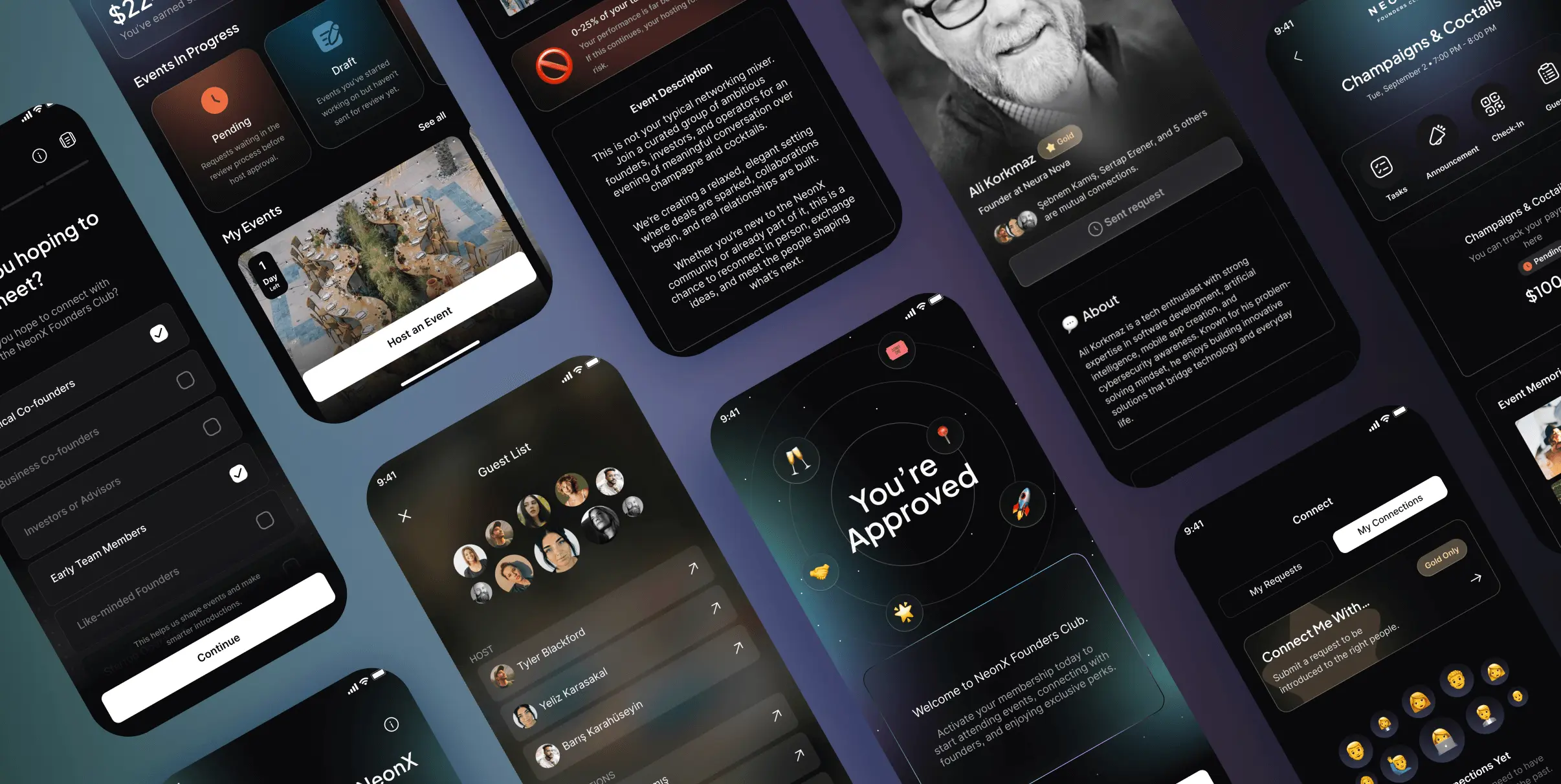
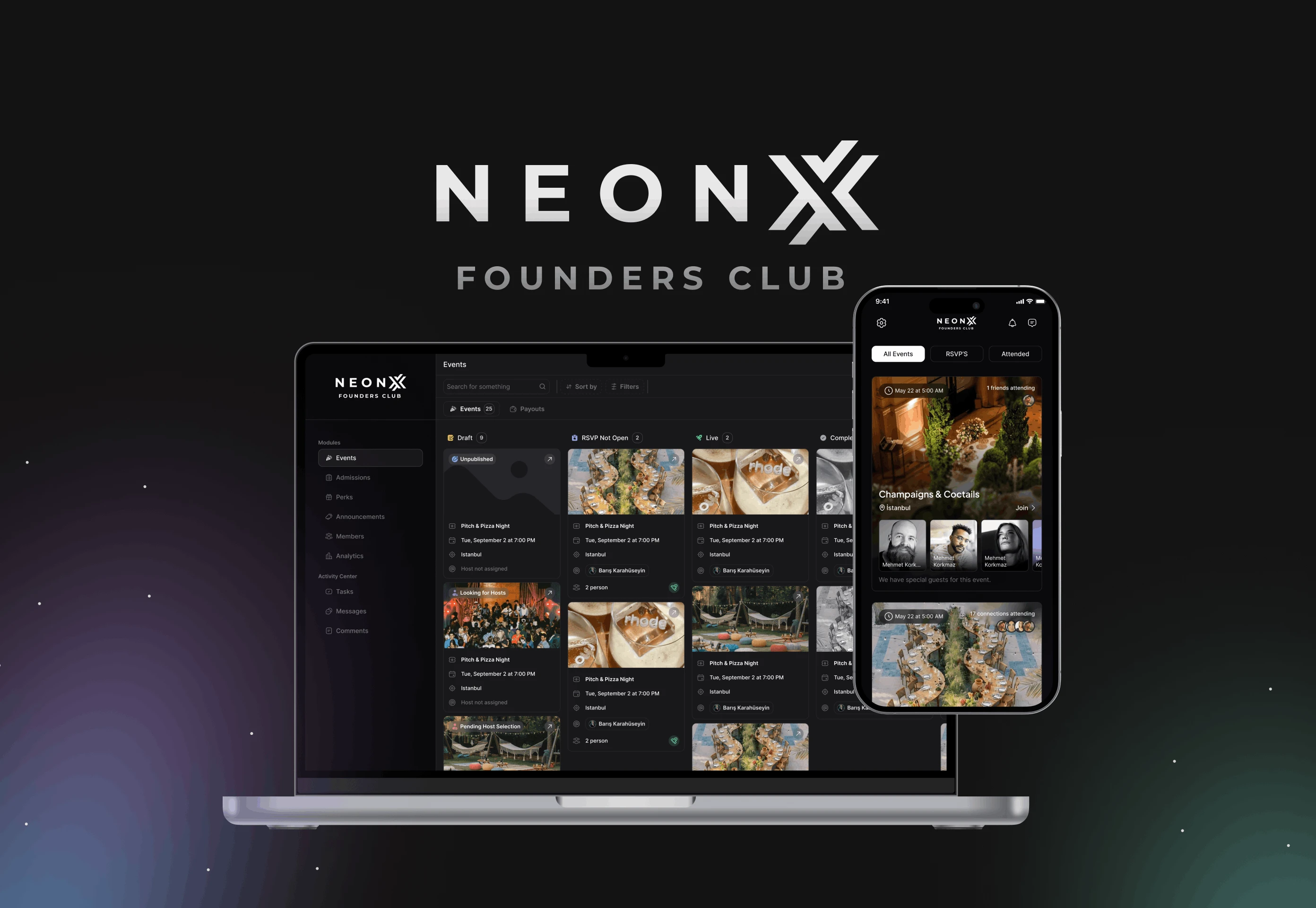
The third trait is event driven activity. Most private communities organize their value around in person meetups, virtual roundtables, cohort programs, or curated content drops. The mobile app is the connective tissue between events, not the primary destination. In Founders Club, for example, we centered the home screen on upcoming events hosted by the community, with the app's other features built to support the connections those events create.
The Five Core Layers of a Private Community App
A working private community app has five technical layers that have to be designed together. Treating any one of them as an afterthought weakens the rest.
Layer | Purpose | Common Decisions |
Verification | Confirm applicant identity and eligibility | Manual review, automated checks, hybrid flows |
Member directory | Display members with structured profiles | Public vs gated profiles, search and filtering |
Events and RSVP | Manage in person and virtual gatherings | Calendar sync, capacity, waitlists, reminders |
Messaging | Allow one to one and small group conversation | Direct messages, group chats, request flows |
Feed and updates | Surface community shared content and announcements | Chronological vs curated, posting permissions |
Each layer carries decisions that compound. A verification flow that approves applicants in five minutes feels fast but produces lower quality membership than one that takes two weeks. A member directory that exposes everyone to everyone weakens the gated feel. A feed that anyone can post to becomes noisy quickly. The right choices depend on the community's purpose, the founder's tolerance for moderation, and how exclusive the brand wants to feel.
In Founders Club, we designed the home screen to highlight upcoming Neon hosted events first, then connection activity. Each founder profile carries verification status, and the build supports RSVP for meetups, panels, and workshops directly inside the app. We also built private messaging so members can continue conversations after an event ends. The architecture follows the community's purpose: real meetings first, app activity second.


Trust and Verification: The Hardest Part
Verification is the part of the build that founders consistently underestimate. The technology is straightforward, the policy is hard. The team has to decide who counts, what evidence is required, what happens when the evidence is ambiguous, and how to handle rejected applicants. None of these are engineering questions, but every one of them shapes the engineering work.
Manual verification means a person reviews every applicant. It produces the highest quality membership and the slowest funnel. Most early stage private communities start manual because the volume is small enough to handle and the quality bar is the product. As applications grow, the team adds automated checks: domain verification (work email), social proof (LinkedIn or company URL), payment verification (the membership fee itself filters), and identity verification through third party providers like Persona or Stripe Identity.
Hybrid flows are the most common pattern at scale. Automated checks fast track obvious approvals, edge cases route to a human reviewer, and rejected applicants get a clear path to appeal. The hybrid model preserves the gate without making the team the bottleneck. Building this layer well takes longer than building messaging, the directory, or the feed. Underestimating it is the most common reason private community apps stall after launch.
There is also a softer trust layer that the verification flow alone cannot solve: how the app communicates membership status to other members. A verified badge, a clear profile structure, and a moderator presence all signal that the gate is real. Without these signals, even a properly verified community can feel like any other social app.
Engagement Loops in Small Communities
Open social apps optimize for daily active users. Private community apps usually optimize for weekly active members. The metric difference is more than cosmetic. It changes which features matter and which features become noise.
Event driven engagement is the central loop. Members join the community to attend something specific: a dinner, a workshop, a panel, a cohort. The app's job is to support that loop: announce events, handle RSVPs, send reminders, and facilitate follow up after the event. Engagement is bursty, not constant. A member might open the app three times the week of an event and twice the following week, and that pattern is a sign of health, not weakness.
The second loop is peer connection. After members meet in person or in a virtual session, they continue conversations through messaging or shared posts. The app's job here is to make the after event easier than it would be on email or LinkedIn. Members should find each other quickly, message without friction, and surface shared interests through structured profile fields.
The third loop is curated content and announcements. The community's editorial voice (often the founder, sometimes a community manager) sets the tone with posts, recaps, and member spotlights. Unlike algorithmic feeds, the volume here is low and the quality is high. Members visit to read what the community is paying attention to, not to scroll endlessly. The feed is a magazine, not a stream.
A common mistake is to add public social features (likes, follower counts, viral mechanics) hoping to boost engagement. In small communities, these features rarely help and often hurt. They turn relationships into performance and shift the culture toward visibility over substance. Most successful private communities deliberately remove or downweight these features.

How to Choose Your Build Approach
Three approaches exist for building a private community app: off the shelf platforms, white label products, and custom builds. Each has a place.
Off the shelf platforms like Mighty Networks, Circle, and Bettermode let teams launch a community in days. The platform handles hosting, moderation tools, and basic mobile apps. The tradeoff is brand control, custom verification, and unique workflows. Most off the shelf platforms cannot enforce a deep verification gate, integrate with custom event flows, or support a fully branded mobile experience. They are the right choice when speed of launch matters more than control.
White label apps like Disciple, Tribe, or Outverse offer more customization than fully off the shelf platforms. The team gets a branded mobile app and some control over feature configuration. The tradeoff is that the underlying platform still constrains what is possible, and the team is dependent on the vendor's roadmap.
Custom builds are necessary when the verification flow is unique, when the community needs deep brand differentiation, when integration with the founder's existing tools matters, or when the community expects to scale beyond what off the shelf platforms support. Custom builds take three to nine months depending on scope. Founders Club took six months from start to build completion, and the time was justified by the verification flow, the event integration, and the brand led design.
The decision usually comes down to two questions. First, is the community's identity tied to its app experience or independent of it? Second, will the community grow into a long term business that justifies an owned codebase? When both answers point to yes, custom is the right call. When either points to no, an off the shelf platform is faster and cheaper. Teams evaluating this choice often work with mobile app development partners who have shipped both kinds of products and can scope the tradeoffs against the actual community plan.
related projects
FAQ
How long does it take to build a private community app?
What does Neon Apps bring to private community app projects?
Should I build a custom community app or use an off the shelf platform?
How does Neon Apps approach verification in a private community app?
What are the biggest mistakes in private community app development?
Stay Inspired
Get fresh design insights, articles, and resources delivered straight to your inbox.
Get stories, insights, and updates from the Neon Apps team straight to your inbox.
Latest Blogs


Stay Inspired
Get stories, insights, and updates from the Neon Apps team straight to your inbox.
Got a project?
Let's Connect
Got a project? We build world-class mobile and web apps for startups and global brands.

Neon Apps is a product development company building mobile, web, and SaaS products with an 85-member in-house team in Istanbul and New York, delivering scalable products as a long-term development partner.
Industries
Primary Services
Delivery & Product Services
Supporting Services
Development
How to Build a Private Community App
How to Build a Private Community App
A practical guide to building private community apps for professionals, with architecture decisions and lessons from Founders Club for NeonX Ventures.
A practical guide to building private community apps for professionals, with architecture decisions and lessons from Founders Club for NeonX Ventures.
How to Build a Private Community App for Professionals: Lessons from Founders Club
Private community apps have moved from niche to mainstream. Hampton, Pavilion, Polywork, Geneva, and dozens of curated networks have shown that small verified groups produce more engagement, more trust, and more long term retention than open social platforms. The pattern matters because the playbook for building these apps is different from the playbook for mass social products. Verification, intentional smallness, and event driven activity replace virality, recommendation feeds, and engagement growth at all costs. Across the 500+ products our team has shipped, the most recent example in this category is Founders Club for NeonX Ventures, a verified founder community we built over six months and are preparing for launch. This guide breaks down what makes a private community app different, the five layers of its architecture, and how to decide between custom and off the shelf builds.
The Private Community App Landscape in 2026
Private community apps are growing because public social media is becoming harder to use for real conversation. Open platforms reward attention, not relationship. Users who want substance, peer learning, or trusted introductions have been moving to smaller, gated spaces. Hampton charges $8,400 per year for a CEO community. Pavilion built a SaaS leadership network with a careful gating layer. Geneva and Polywork serve niche professional groups with similar mechanics. The category is now well established and the business model is proven.
The shared pattern is clear. These apps trade scale for trust. They use a verification gate to keep out spam and tourists. They organize activity around events and discussions rather than feeds. They charge a meaningful fee, sometimes annually, sometimes per cohort. They focus on retention measured in weekly active members rather than daily active users. The result is a smaller community that produces more value per member than a larger open one.
For founders entering this category, the first lesson is that the technical work is real but tractable. The harder work is community design: who is allowed in, what activities sustain engagement, and how the community keeps its quality as it grows. A well built app cannot fix a poorly designed community, but a poorly built app can break a great one.
What Makes a Private Community App Different
Private community app: A members only mobile or web product where access is granted through verification rather than open signup. The app's core purpose is to facilitate trusted interaction between vetted members, usually a defined professional or interest group, often around recurring events, shared content, or peer connection.
The defining trait is the verification gate. A public social app onboards anyone with an email. A private community app evaluates each applicant against a defined membership criterion: verified founder, paying SaaS executive, alumni of a specific program, owner of a verified business. The gate is the product. Without it, the community loses its trust and value.
The second defining trait is intentional smallness. Most private communities operate at hundreds or low thousands of members rather than millions. The architecture, moderation model, and engagement design all shift when the team is optimizing for a few thousand active users instead of a few million. Recommendation algorithms become unnecessary. Discovery becomes manual or curated. Member to member trust becomes feasible because the population is small enough to know.
The third trait is event driven activity. Most private communities organize their value around in person meetups, virtual roundtables, cohort programs, or curated content drops. The mobile app is the connective tissue between events, not the primary destination. In Founders Club, for example, we centered the home screen on upcoming events hosted by the community, with the app's other features built to support the connections those events create.
The Five Core Layers of a Private Community App
A working private community app has five technical layers that have to be designed together. Treating any one of them as an afterthought weakens the rest.
Layer | Purpose | Common Decisions |
Verification | Confirm applicant identity and eligibility | Manual review, automated checks, hybrid flows |
Member directory | Display members with structured profiles | Public vs gated profiles, search and filtering |
Events and RSVP | Manage in person and virtual gatherings | Calendar sync, capacity, waitlists, reminders |
Messaging | Allow one to one and small group conversation | Direct messages, group chats, request flows |
Feed and updates | Surface community shared content and announcements | Chronological vs curated, posting permissions |
Each layer carries decisions that compound. A verification flow that approves applicants in five minutes feels fast but produces lower quality membership than one that takes two weeks. A member directory that exposes everyone to everyone weakens the gated feel. A feed that anyone can post to becomes noisy quickly. The right choices depend on the community's purpose, the founder's tolerance for moderation, and how exclusive the brand wants to feel.
In Founders Club, we designed the home screen to highlight upcoming Neon hosted events first, then connection activity. Each founder profile carries verification status, and the build supports RSVP for meetups, panels, and workshops directly inside the app. We also built private messaging so members can continue conversations after an event ends. The architecture follows the community's purpose: real meetings first, app activity second.
Trust and Verification: The Hardest Part
Verification is the part of the build that founders consistently underestimate. The technology is straightforward, the policy is hard. The team has to decide who counts, what evidence is required, what happens when the evidence is ambiguous, and how to handle rejected applicants. None of these are engineering questions, but every one of them shapes the engineering work.
Manual verification means a person reviews every applicant. It produces the highest quality membership and the slowest funnel. Most early stage private communities start manual because the volume is small enough to handle and the quality bar is the product. As applications grow, the team adds automated checks: domain verification (work email), social proof (LinkedIn or company URL), payment verification (the membership fee itself filters), and identity verification through third party providers like Persona or Stripe Identity.
Hybrid flows are the most common pattern at scale. Automated checks fast track obvious approvals, edge cases route to a human reviewer, and rejected applicants get a clear path to appeal. The hybrid model preserves the gate without making the team the bottleneck. Building this layer well takes longer than building messaging, the directory, or the feed. Underestimating it is the most common reason private community apps stall after launch.
There is also a softer trust layer that the verification flow alone cannot solve: how the app communicates membership status to other members. A verified badge, a clear profile structure, and a moderator presence all signal that the gate is real. Without these signals, even a properly verified community can feel like any other social app.
Engagement Loops in Small Communities
Open social apps optimize for daily active users. Private community apps usually optimize for weekly active members. The metric difference is more than cosmetic. It changes which features matter and which features become noise.
Event driven engagement is the central loop. Members join the community to attend something specific: a dinner, a workshop, a panel, a cohort. The app's job is to support that loop: announce events, handle RSVPs, send reminders, and facilitate follow up after the event. Engagement is bursty, not constant. A member might open the app three times the week of an event and twice the following week, and that pattern is a sign of health, not weakness.
The second loop is peer connection. After members meet in person or in a virtual session, they continue conversations through messaging or shared posts. The app's job here is to make the after event easier than it would be on email or LinkedIn. Members should find each other quickly, message without friction, and surface shared interests through structured profile fields.
The third loop is curated content and announcements. The community's editorial voice (often the founder, sometimes a community manager) sets the tone with posts, recaps, and member spotlights. Unlike algorithmic feeds, the volume here is low and the quality is high. Members visit to read what the community is paying attention to, not to scroll endlessly. The feed is a magazine, not a stream.
A common mistake is to add public social features (likes, follower counts, viral mechanics) hoping to boost engagement. In small communities, these features rarely help and often hurt. They turn relationships into performance and shift the culture toward visibility over substance. Most successful private communities deliberately remove or downweight these features.
How to Choose Your Build Approach
Three approaches exist for building a private community app: off the shelf platforms, white label products, and custom builds. Each has a place.
Off the shelf platforms like Mighty Networks, Circle, and Bettermode let teams launch a community in days. The platform handles hosting, moderation tools, and basic mobile apps. The tradeoff is brand control, custom verification, and unique workflows. Most off the shelf platforms cannot enforce a deep verification gate, integrate with custom event flows, or support a fully branded mobile experience. They are the right choice when speed of launch matters more than control.
White label apps like Disciple, Tribe, or Outverse offer more customization than fully off the shelf platforms. The team gets a branded mobile app and some control over feature configuration. The tradeoff is that the underlying platform still constrains what is possible, and the team is dependent on the vendor's roadmap.
Custom builds are necessary when the verification flow is unique, when the community needs deep brand differentiation, when integration with the founder's existing tools matters, or when the community expects to scale beyond what off the shelf platforms support. Custom builds take three to nine months depending on scope. Founders Club took six months from start to build completion, and the time was justified by the verification flow, the event integration, and the brand led design.
The decision usually comes down to two questions. First, is the community's identity tied to its app experience or independent of it? Second, will the community grow into a long term business that justifies an owned codebase? When both answers point to yes, custom is the right call. When either points to no, an off the shelf platform is faster and cheaper. Teams evaluating this choice often work with mobile app development partners who have shipped both kinds of products and can scope the tradeoffs against the actual community plan.
related projects
FAQ
How long does it take to build a private community app?
What does Neon Apps bring to private community app projects?
Should I build a custom community app or use an off the shelf platform?
How does Neon Apps approach verification in a private community app?
What are the biggest mistakes in private community app development?
Stay Inspired
Get fresh design insights, articles, and resources delivered straight to your inbox.
Get stories, insights, and updates from the Neon Apps team straight to your inbox.
Latest Blogs
Stay Inspired
Get stories, insights, and updates from the Neon Apps team straight to your inbox.
Got a project?
Let's Connect
Got a project? We build world-class mobile and web apps for startups and global brands.
Neon Apps is a product development company building mobile, web, and SaaS products with an 85-member in-house team in Istanbul and New York, delivering scalable products as a long-term development partner.
Industries
Primary Services
Delivery & Product Services
Supporting Services
Development
How to Build a Private Community App
How to Build a Private Community App
A practical guide to building private community apps for professionals, with architecture decisions and lessons from Founders Club for NeonX Ventures.
A practical guide to building private community apps for professionals, with architecture decisions and lessons from Founders Club for NeonX Ventures.
How to Build a Private Community App for Professionals: Lessons from Founders Club
Private community apps have moved from niche to mainstream. Hampton, Pavilion, Polywork, Geneva, and dozens of curated networks have shown that small verified groups produce more engagement, more trust, and more long term retention than open social platforms. The pattern matters because the playbook for building these apps is different from the playbook for mass social products. Verification, intentional smallness, and event driven activity replace virality, recommendation feeds, and engagement growth at all costs. Across the 500+ products our team has shipped, the most recent example in this category is Founders Club for NeonX Ventures, a verified founder community we built over six months and are preparing for launch. This guide breaks down what makes a private community app different, the five layers of its architecture, and how to decide between custom and off the shelf builds.
The Private Community App Landscape in 2026
Private community apps are growing because public social media is becoming harder to use for real conversation. Open platforms reward attention, not relationship. Users who want substance, peer learning, or trusted introductions have been moving to smaller, gated spaces. Hampton charges $8,400 per year for a CEO community. Pavilion built a SaaS leadership network with a careful gating layer. Geneva and Polywork serve niche professional groups with similar mechanics. The category is now well established and the business model is proven.
The shared pattern is clear. These apps trade scale for trust. They use a verification gate to keep out spam and tourists. They organize activity around events and discussions rather than feeds. They charge a meaningful fee, sometimes annually, sometimes per cohort. They focus on retention measured in weekly active members rather than daily active users. The result is a smaller community that produces more value per member than a larger open one.
For founders entering this category, the first lesson is that the technical work is real but tractable. The harder work is community design: who is allowed in, what activities sustain engagement, and how the community keeps its quality as it grows. A well built app cannot fix a poorly designed community, but a poorly built app can break a great one.
What Makes a Private Community App Different
Private community app: A members only mobile or web product where access is granted through verification rather than open signup. The app's core purpose is to facilitate trusted interaction between vetted members, usually a defined professional or interest group, often around recurring events, shared content, or peer connection.
The defining trait is the verification gate. A public social app onboards anyone with an email. A private community app evaluates each applicant against a defined membership criterion: verified founder, paying SaaS executive, alumni of a specific program, owner of a verified business. The gate is the product. Without it, the community loses its trust and value.
The second defining trait is intentional smallness. Most private communities operate at hundreds or low thousands of members rather than millions. The architecture, moderation model, and engagement design all shift when the team is optimizing for a few thousand active users instead of a few million. Recommendation algorithms become unnecessary. Discovery becomes manual or curated. Member to member trust becomes feasible because the population is small enough to know.
The third trait is event driven activity. Most private communities organize their value around in person meetups, virtual roundtables, cohort programs, or curated content drops. The mobile app is the connective tissue between events, not the primary destination. In Founders Club, for example, we centered the home screen on upcoming events hosted by the community, with the app's other features built to support the connections those events create.
The Five Core Layers of a Private Community App
A working private community app has five technical layers that have to be designed together. Treating any one of them as an afterthought weakens the rest.
Layer | Purpose | Common Decisions |
Verification | Confirm applicant identity and eligibility | Manual review, automated checks, hybrid flows |
Member directory | Display members with structured profiles | Public vs gated profiles, search and filtering |
Events and RSVP | Manage in person and virtual gatherings | Calendar sync, capacity, waitlists, reminders |
Messaging | Allow one to one and small group conversation | Direct messages, group chats, request flows |
Feed and updates | Surface community shared content and announcements | Chronological vs curated, posting permissions |
Each layer carries decisions that compound. A verification flow that approves applicants in five minutes feels fast but produces lower quality membership than one that takes two weeks. A member directory that exposes everyone to everyone weakens the gated feel. A feed that anyone can post to becomes noisy quickly. The right choices depend on the community's purpose, the founder's tolerance for moderation, and how exclusive the brand wants to feel.
In Founders Club, we designed the home screen to highlight upcoming Neon hosted events first, then connection activity. Each founder profile carries verification status, and the build supports RSVP for meetups, panels, and workshops directly inside the app. We also built private messaging so members can continue conversations after an event ends. The architecture follows the community's purpose: real meetings first, app activity second.
Trust and Verification: The Hardest Part
Verification is the part of the build that founders consistently underestimate. The technology is straightforward, the policy is hard. The team has to decide who counts, what evidence is required, what happens when the evidence is ambiguous, and how to handle rejected applicants. None of these are engineering questions, but every one of them shapes the engineering work.
Manual verification means a person reviews every applicant. It produces the highest quality membership and the slowest funnel. Most early stage private communities start manual because the volume is small enough to handle and the quality bar is the product. As applications grow, the team adds automated checks: domain verification (work email), social proof (LinkedIn or company URL), payment verification (the membership fee itself filters), and identity verification through third party providers like Persona or Stripe Identity.
Hybrid flows are the most common pattern at scale. Automated checks fast track obvious approvals, edge cases route to a human reviewer, and rejected applicants get a clear path to appeal. The hybrid model preserves the gate without making the team the bottleneck. Building this layer well takes longer than building messaging, the directory, or the feed. Underestimating it is the most common reason private community apps stall after launch.
There is also a softer trust layer that the verification flow alone cannot solve: how the app communicates membership status to other members. A verified badge, a clear profile structure, and a moderator presence all signal that the gate is real. Without these signals, even a properly verified community can feel like any other social app.
Engagement Loops in Small Communities
Open social apps optimize for daily active users. Private community apps usually optimize for weekly active members. The metric difference is more than cosmetic. It changes which features matter and which features become noise.
Event driven engagement is the central loop. Members join the community to attend something specific: a dinner, a workshop, a panel, a cohort. The app's job is to support that loop: announce events, handle RSVPs, send reminders, and facilitate follow up after the event. Engagement is bursty, not constant. A member might open the app three times the week of an event and twice the following week, and that pattern is a sign of health, not weakness.
The second loop is peer connection. After members meet in person or in a virtual session, they continue conversations through messaging or shared posts. The app's job here is to make the after event easier than it would be on email or LinkedIn. Members should find each other quickly, message without friction, and surface shared interests through structured profile fields.
The third loop is curated content and announcements. The community's editorial voice (often the founder, sometimes a community manager) sets the tone with posts, recaps, and member spotlights. Unlike algorithmic feeds, the volume here is low and the quality is high. Members visit to read what the community is paying attention to, not to scroll endlessly. The feed is a magazine, not a stream.
A common mistake is to add public social features (likes, follower counts, viral mechanics) hoping to boost engagement. In small communities, these features rarely help and often hurt. They turn relationships into performance and shift the culture toward visibility over substance. Most successful private communities deliberately remove or downweight these features.
How to Choose Your Build Approach
Three approaches exist for building a private community app: off the shelf platforms, white label products, and custom builds. Each has a place.
Off the shelf platforms like Mighty Networks, Circle, and Bettermode let teams launch a community in days. The platform handles hosting, moderation tools, and basic mobile apps. The tradeoff is brand control, custom verification, and unique workflows. Most off the shelf platforms cannot enforce a deep verification gate, integrate with custom event flows, or support a fully branded mobile experience. They are the right choice when speed of launch matters more than control.
White label apps like Disciple, Tribe, or Outverse offer more customization than fully off the shelf platforms. The team gets a branded mobile app and some control over feature configuration. The tradeoff is that the underlying platform still constrains what is possible, and the team is dependent on the vendor's roadmap.
Custom builds are necessary when the verification flow is unique, when the community needs deep brand differentiation, when integration with the founder's existing tools matters, or when the community expects to scale beyond what off the shelf platforms support. Custom builds take three to nine months depending on scope. Founders Club took six months from start to build completion, and the time was justified by the verification flow, the event integration, and the brand led design.
The decision usually comes down to two questions. First, is the community's identity tied to its app experience or independent of it? Second, will the community grow into a long term business that justifies an owned codebase? When both answers point to yes, custom is the right call. When either points to no, an off the shelf platform is faster and cheaper. Teams evaluating this choice often work with mobile app development partners who have shipped both kinds of products and can scope the tradeoffs against the actual community plan.
related projects
FAQ
How long does it take to build a private community app?
What does Neon Apps bring to private community app projects?
Should I build a custom community app or use an off the shelf platform?
How does Neon Apps approach verification in a private community app?
What are the biggest mistakes in private community app development?
Stay Inspired
Get fresh design insights, articles, and resources delivered straight to your inbox.
Get stories, insights, and updates from the Neon Apps team straight to your inbox.
Latest Blogs
Stay Inspired
Get stories, insights, and updates from the Neon Apps team straight to your inbox.
Got a project?
Let's Connect
Got a project? We build world-class mobile and web apps for startups and global brands.
Neon Apps is a product development company building mobile, web, and SaaS products with an 85-member in-house team in Istanbul and New York, delivering scalable products as a long-term development partner.
Industries
Primary Services
Delivery & Product Services
Supporting Services