
Development
How to Build a Quiz or Personality App: Lessons from Mygen
How to Build a Quiz or Personality App: Lessons from Mygen

A practical guide to building quiz and personality apps in 2026. Architecture, viral mechanics, and lessons from Mygen for Onedio.
A practical guide to building quiz and personality apps in 2026. Architecture, viral mechanics, and lessons from Mygen for Onedio.
Quiz Apps in 2026: The Architecture Behind the Viral Few
Quiz and personality apps occupy a strange spot in the mobile landscape. They look simple, ship fast, and yet a small group of products in this category have hundreds of millions of users while most copies get nowhere. The difference is rarely the quiz logic itself. It is the result page, the share flow, and the loop that brings users back for the next quiz. In 2026 the category continues to grow because short, shareable self discovery content fits the way people use their phones in idle moments. Across the 500+ products our team has shipped, the most recent example in this space is Mygen for Onedio, a personality and character quiz app delivered in two months that turns short quizzes into shareable result cards. This guide breaks down what makes a quiz app work, the four parts of its architecture, and the mechanics that separate quiz apps that grow from ones that fade.
The Quiz App Landscape in 2026
Quiz and personality apps cover a wide range. There are short BuzzFeed style entertainment quizzes, structured personality frameworks like 16 Personalities, character matching apps, language learning quizzes, and brand led campaigns that use quizzes as marketing tools. The technical architecture is similar across all of them, but the user motivation is different. Entertainment quizzes thrive on shareability. Personality frameworks live or die by perceived accuracy. Educational quizzes succeed through repeat use and progress tracking.
The category is steady because it taps into a basic human behavior. People want to learn something about themselves and they want to share it. Mobile makes both of these things effortless. A user can take a quiz in two minutes during a coffee break and post the result to social media before their next call. The phones, the platforms, and the social graphs are already there. The app just has to make the experience feel light and the result worth sharing.
What has changed in 2026 is that AI has lowered the cost of producing content. A team that used to need a writer to draft 50 quizzes can now generate a working draft with an LLM and edit from there. The constraint is no longer quiz volume, it is quiz quality. Apps that ship dozens of low quality AI generated quizzes lose users quickly. Apps that ship fewer, better tuned quizzes hold attention longer. The opportunity is real, but the bar for quality is higher than the surface suggests.
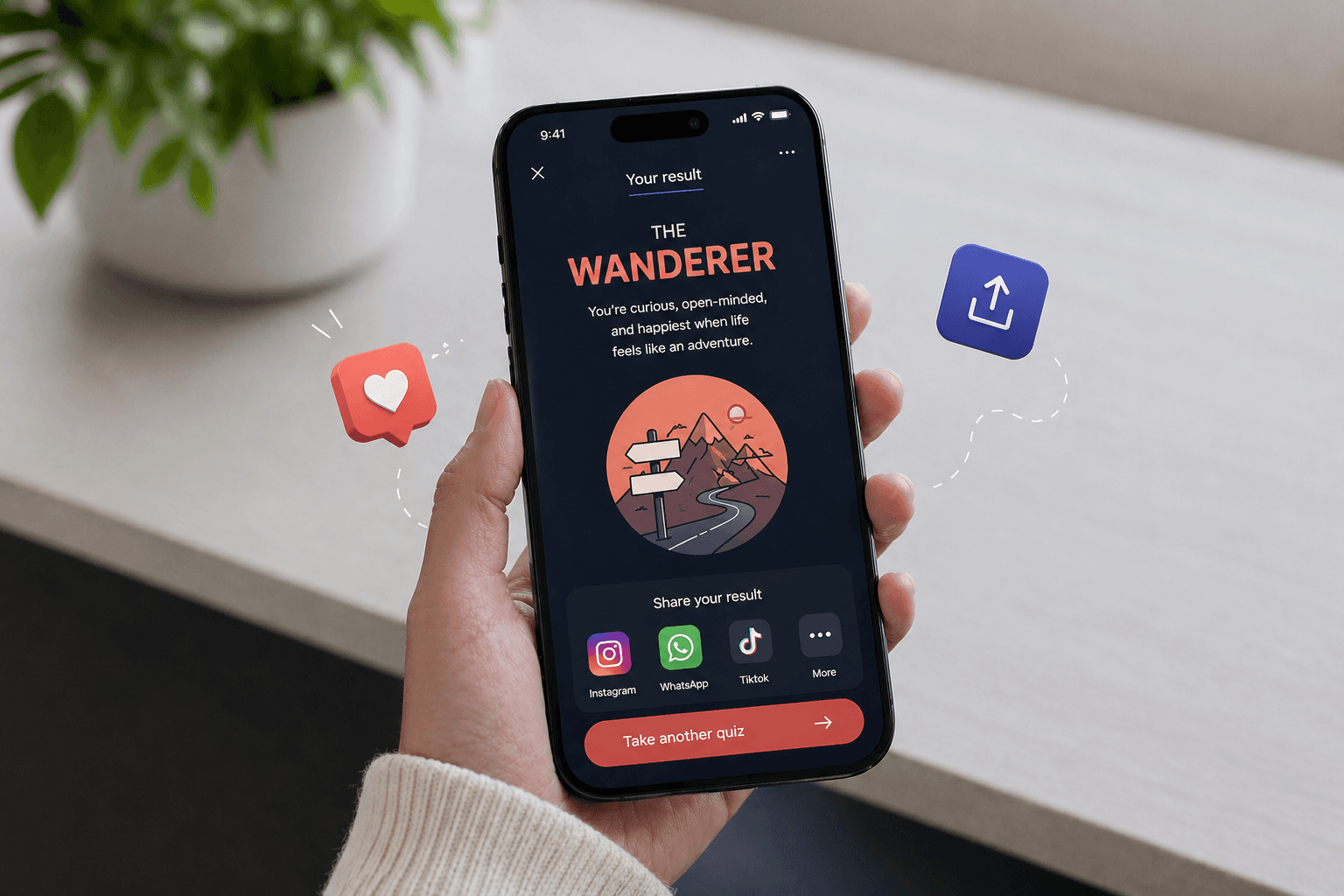
What a Quiz or Personality App Actually Does
Quiz or personality app: A mobile app that presents a structured set of questions to the user, applies a scoring or matching algorithm to the answers, and returns a personalized result. The result usually takes the form of a shareable card, a personality type, a character match, or a recommendation, designed for both immediate user satisfaction and external sharing on social platforms.
The category has three common patterns. The first is the entertainment quiz, which uses light personality questions to match the user with a character, a celebrity, a fictional type, or a meme. The second is the personality framework, which applies a structured psychological model (Big Five, MBTI inspired, attachment styles) to produce a typed result the user identifies with. The third is the campaign quiz, often used for marketing or lead generation, where the result connects to a product, service, or brand message. Mygen for Onedio sits in the entertainment category, with quizzes that match users to characters or figures based on personality themes inspired by movies, culture, and mood.
The pattern that ties all three together is the result page. The quiz itself is a delivery mechanism for the result. If the result feels accurate, satisfying, or shareable, the user returns and brings friends. If the result feels generic or random, the app loses the user after one session. Most failed quiz apps fail at the result page, not at the quiz logic.
Part | Purpose | Common Decisions |
|---|---|---|
Quiz catalog | Store and serve quizzes | CMS approach, refresh cadence, themed categories |
Question flow | Present questions and capture answers | One at a time, multiple choice, visual answers, progress indicator |
Scoring engine | Map answers to a result | Weighted scoring, tag matching, type assignment |
Result page | Present the result and enable sharing | Card design, copy variations, share targets |
Quiz Catalog and Refresh Cadence
The quiz catalog is the content engine of the app. A user who finishes a quiz wants another one quickly. If the catalog is shallow or stale, the user closes the app and forgets it exists. The catalog needs depth at launch and a steady refresh cadence after.
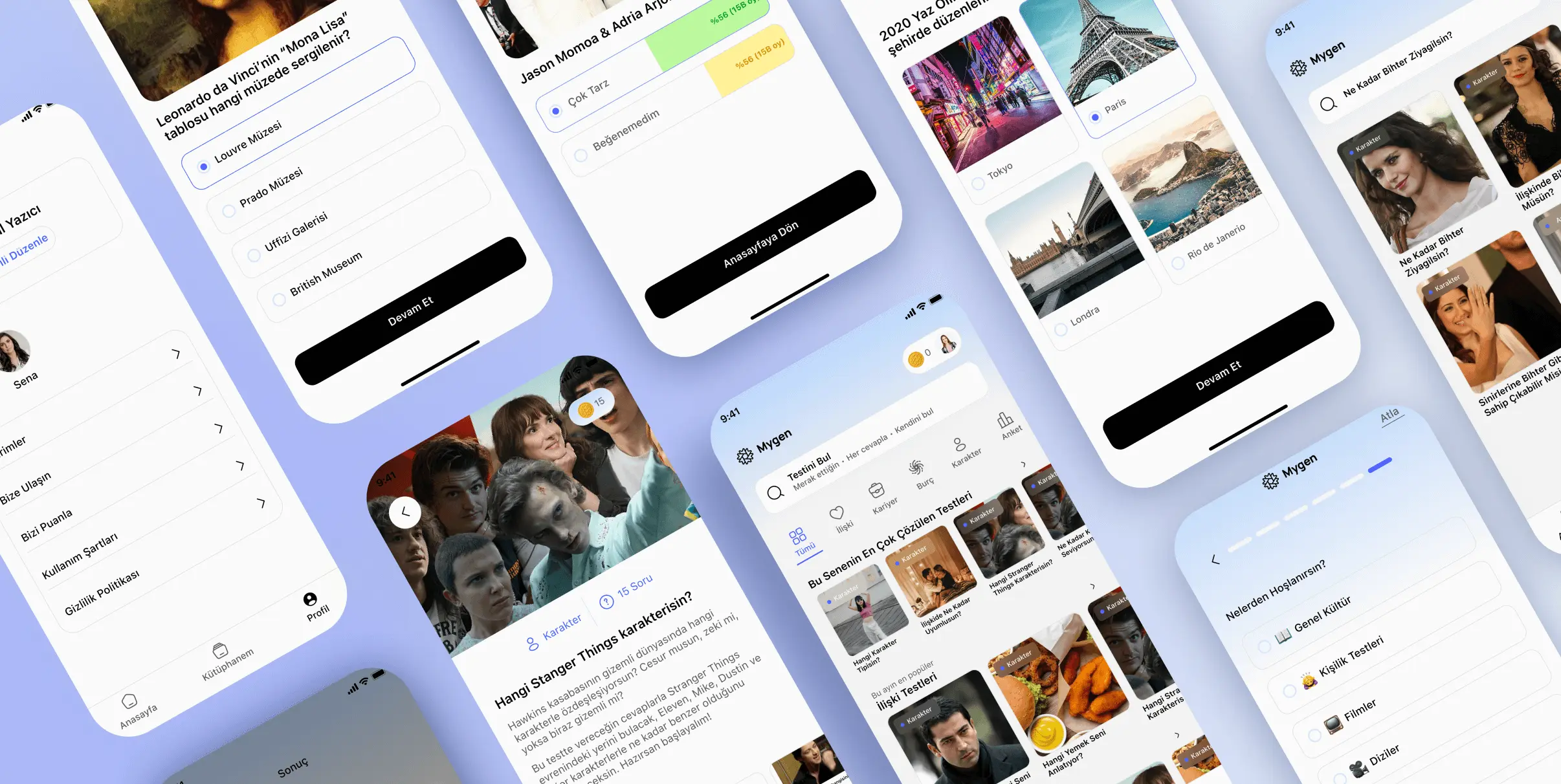
For Mygen, the home screen highlights new quizzes regularly so users always have something fresh to try. The cadence matters more than the volume. Releasing two new quizzes a week keeps the app feeling alive. Releasing 20 quizzes once a month and going dark for three weeks does not. The catalog also needs structure. Themed categories, character based collections, mood matched groupings, all help users find a quiz that fits their current state.
The CMS choice also matters. A team that ships quizzes through engineering tickets cannot keep up with a weekly cadence. The right structure is a content workflow where editorial team members can author, preview, and publish quizzes without engineering involvement. Headless CMS platforms like Contentful, Sanity, or Strapi handle this cleanly when integrated with the app's content fetch layer.
Question Flow Design
The question flow is where the user spends the most time, but it is also where founders most often overcomplicate the experience. The right baseline is one question at a time, four to six answer options per question, and a clear progress indicator. Long forms with all questions on a single screen feel like surveys and lose users in the first three taps.
Visual answers (image cards instead of text) increase engagement on entertainment quizzes but require more design work and can slow the flow if images are heavy. Text only answers ship faster and load instantly, which matters more than founders expect for an audience that scrolls through quizzes during short attention windows.
The optimal quiz length depends on the category. Entertainment quizzes work best at 7 to 12 questions. Personality frameworks tolerate 20 to 40 questions because users expect depth. Anything longer than 40 questions drops completion rates sharply, regardless of category.
Scoring Engine
The scoring engine is the part that translates answers into results. Three common patterns cover most quiz apps. The first is weighted scoring, where each answer contributes points to one or more dimensions, and the highest scoring dimension produces the result. The second is tag matching, where each answer attaches tags and the result is the type with the most tag overlap. The third is decision tree branching, where the answer to one question determines which question comes next, and the path through the tree produces the result.
For most entertainment and personality quizzes, weighted scoring is the simplest and most flexible approach. Tag matching works well when the result space is large (dozens of possible characters or types). Branching is best for quizzes where the experience itself is the point and the path through the questions is part of the storytelling.
The scoring logic is where many quiz apps quietly fail. Algorithms that produce the same result for too many users feel broken. Algorithms that produce truly random results feel arbitrary. The middle ground, where similar answers reliably produce similar results but the result space is wide enough to feel personalized, is the engineering goal. This usually requires testing the algorithm against real user answer patterns and tuning the weights based on actual distribution.
Result Page and Sharing
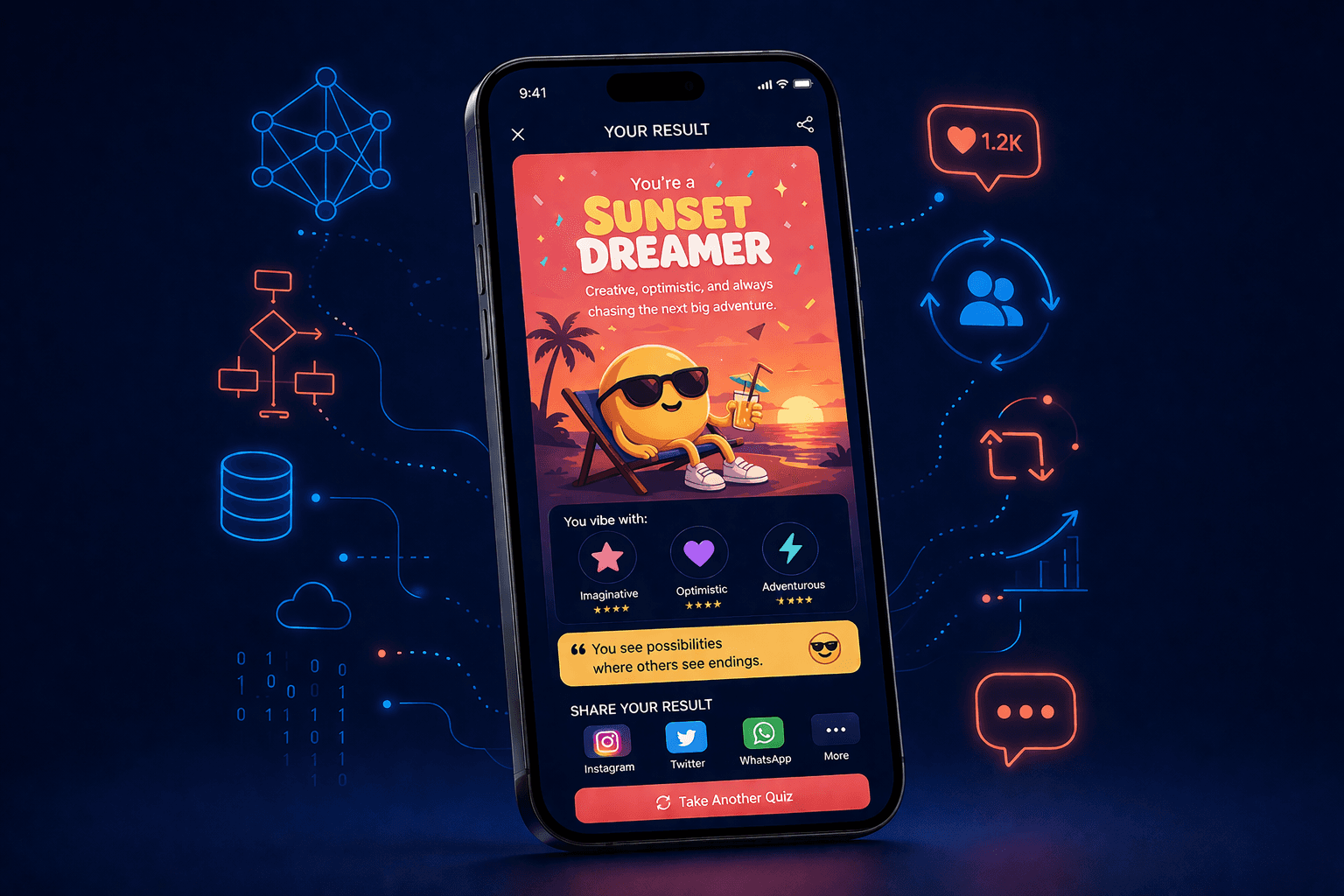
The result page is the most important screen in the app. The user spent two minutes earning this output, and the next 30 seconds decide whether they share it, save it, or forget it. The result page needs to feel personalized, look good on a screenshot, and offer a one tap share to the platforms the audience actually uses.
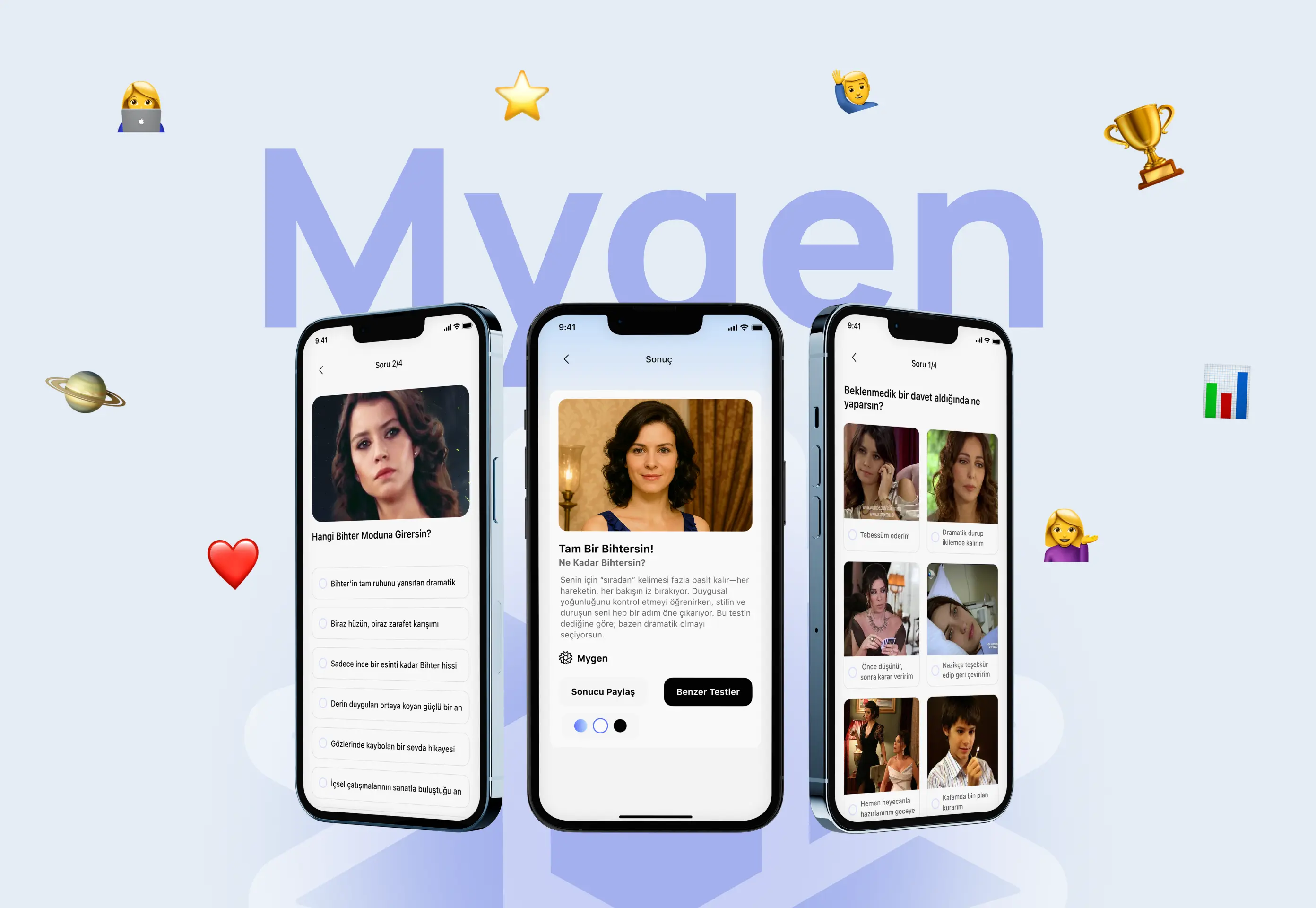
In Mygen, each result includes a short explanation and a visual card designed for sharing on social platforms. The card format matters because users post results to Instagram Stories, X, WhatsApp, or TikTok, and the dimensions, colors, and text density of the card determine whether the share actually happens. A card that looks great on the user's phone but is cropped or hard to read on a friend's feed loses the share. Square or 9:16 vertical formats work best across the major social targets in 2026.
Share copy is equally important. Auto generated share text that says "I just took this quiz" performs worse than text that includes the actual result and a tease for the friend. "I'm a [Result Name], take the quiz to find out yours" outperforms generic share copy by significant margins. The share flow is the growth engine of a quiz app, and copy is most of it.
Engagement and Retention Loops
Quiz apps face a specific retention challenge. The user gets a satisfying result, shares it, and is then done with that quiz forever. The next session has to come from somewhere. Three loops carry quiz apps past the first session.
The first is the new quiz loop. Fresh content brings users back. Push notifications announcing new quizzes work well in this category if the cadence is right. Daily notifications feel spammy. Weekly notifications feel timely. Most successful quiz apps land between two and four notifications per week, often timed to mood or event windows (weekend, lunch break, evening commute).
The second is the social loop. When a user shares a result, friends see it and either take the quiz themselves (instant viral growth) or react to the shared result (which the original user sees and returns to the app for). The viral coefficient of a quiz app is usually higher than other entertainment categories because the sharing intent is built into the result itself.
The third is the collection loop. Users who take multiple quizzes can revisit past results, compare types across quizzes, and see their personality from different angles. Mygen lets users revisit past results and explore different sides of themselves over time. This collection feel turns a one off quiz into a small personal archive, which is enough reason to return.
A common mistake in this category is to copy mechanics from other app types that do not fit. Streaks work in fitness apps but feel forced on a quiz app where daily use is not the goal. Leaderboards work in games but undermine the personal nature of personality quizzes. The features that work here are the ones that respect the casual, shareable, occasional use pattern the audience actually has.
Monetization for Quiz Apps
Most quiz apps use one of three monetization models. The first is advertising, with interstitial or rewarded ads between quizzes. The second is a subscription that removes ads and unlocks premium quizzes or detailed result analysis. The third is free with paid upgrades for specific quiz packs or extended results.
The right choice depends on the audience and the use pattern. Entertainment quiz audiences tolerate ads if the cadence is reasonable, because the use pattern is short and casual. Personality framework audiences are more likely to pay for depth, because the perceived value of a detailed result feels worth a subscription. Brand campaign quizzes do not monetize through the app at all, the value is in the data or the brand moment.
For ad supported quiz apps, the loop is simple: more quizzes per session means more ad impressions per user. The product design has to balance keeping the quiz experience light with surfacing the next quiz before the user closes the app. Apps that get this loop right can sustain CPMs in the typical entertainment app range while keeping retention healthy.
For subscription based quiz apps, the premium tier needs to feel meaningfully different from the free tier. Just removing ads is rarely enough. Premium quizzes, detailed personality reports, comparison features against past results, and exclusive content packs are the kinds of upgrades that justify a recurring fee in this category. Teams entering this space often validate the monetization model in early testing before committing to long term content investment, a pattern our mobile app development team has seen play out across multiple shipped products.
related projects
FAQ
How long does it take to build a quiz or personality app?
What does Neon Apps bring to quiz and personality app projects?
Should I use AI to generate quiz content?
How does Neon Apps approach the result page in a quiz app?
What are the biggest mistakes in quiz app development?
Stay Inspired
Get fresh design insights, articles, and resources delivered straight to your inbox.
Get stories, insights, and updates from the Neon Apps team straight to your inbox.
Latest Blogs


Stay Inspired
Get stories, insights, and updates from the Neon Apps team straight to your inbox.
Got a project?
Let's Connect
Got a project? We build world-class mobile and web apps for startups and global brands.

Neon Apps is a product development company building mobile, web, and SaaS products with an 85-member in-house team in Istanbul and New York, delivering scalable products as a long-term development partner.
Industries
Primary Services
Delivery & Product Services
Supporting Services
Development
How to Build a Quiz or Personality App: Lessons from Mygen
How to Build a Quiz or Personality App: Lessons from Mygen
A practical guide to building quiz and personality apps in 2026. Architecture, viral mechanics, and lessons from Mygen for Onedio.
A practical guide to building quiz and personality apps in 2026. Architecture, viral mechanics, and lessons from Mygen for Onedio.
Quiz Apps in 2026: The Architecture Behind the Viral Few
Quiz and personality apps occupy a strange spot in the mobile landscape. They look simple, ship fast, and yet a small group of products in this category have hundreds of millions of users while most copies get nowhere. The difference is rarely the quiz logic itself. It is the result page, the share flow, and the loop that brings users back for the next quiz. In 2026 the category continues to grow because short, shareable self discovery content fits the way people use their phones in idle moments. Across the 500+ products our team has shipped, the most recent example in this space is Mygen for Onedio, a personality and character quiz app delivered in two months that turns short quizzes into shareable result cards. This guide breaks down what makes a quiz app work, the four parts of its architecture, and the mechanics that separate quiz apps that grow from ones that fade.
The Quiz App Landscape in 2026
Quiz and personality apps cover a wide range. There are short BuzzFeed style entertainment quizzes, structured personality frameworks like 16 Personalities, character matching apps, language learning quizzes, and brand led campaigns that use quizzes as marketing tools. The technical architecture is similar across all of them, but the user motivation is different. Entertainment quizzes thrive on shareability. Personality frameworks live or die by perceived accuracy. Educational quizzes succeed through repeat use and progress tracking.
The category is steady because it taps into a basic human behavior. People want to learn something about themselves and they want to share it. Mobile makes both of these things effortless. A user can take a quiz in two minutes during a coffee break and post the result to social media before their next call. The phones, the platforms, and the social graphs are already there. The app just has to make the experience feel light and the result worth sharing.
What has changed in 2026 is that AI has lowered the cost of producing content. A team that used to need a writer to draft 50 quizzes can now generate a working draft with an LLM and edit from there. The constraint is no longer quiz volume, it is quiz quality. Apps that ship dozens of low quality AI generated quizzes lose users quickly. Apps that ship fewer, better tuned quizzes hold attention longer. The opportunity is real, but the bar for quality is higher than the surface suggests.
What a Quiz or Personality App Actually Does
Quiz or personality app: A mobile app that presents a structured set of questions to the user, applies a scoring or matching algorithm to the answers, and returns a personalized result. The result usually takes the form of a shareable card, a personality type, a character match, or a recommendation, designed for both immediate user satisfaction and external sharing on social platforms.
The category has three common patterns. The first is the entertainment quiz, which uses light personality questions to match the user with a character, a celebrity, a fictional type, or a meme. The second is the personality framework, which applies a structured psychological model (Big Five, MBTI inspired, attachment styles) to produce a typed result the user identifies with. The third is the campaign quiz, often used for marketing or lead generation, where the result connects to a product, service, or brand message. Mygen for Onedio sits in the entertainment category, with quizzes that match users to characters or figures based on personality themes inspired by movies, culture, and mood.
The pattern that ties all three together is the result page. The quiz itself is a delivery mechanism for the result. If the result feels accurate, satisfying, or shareable, the user returns and brings friends. If the result feels generic or random, the app loses the user after one session. Most failed quiz apps fail at the result page, not at the quiz logic.
Part | Purpose | Common Decisions |
|---|---|---|
Quiz catalog | Store and serve quizzes | CMS approach, refresh cadence, themed categories |
Question flow | Present questions and capture answers | One at a time, multiple choice, visual answers, progress indicator |
Scoring engine | Map answers to a result | Weighted scoring, tag matching, type assignment |
Result page | Present the result and enable sharing | Card design, copy variations, share targets |
Quiz Catalog and Refresh Cadence
The quiz catalog is the content engine of the app. A user who finishes a quiz wants another one quickly. If the catalog is shallow or stale, the user closes the app and forgets it exists. The catalog needs depth at launch and a steady refresh cadence after.
For Mygen, the home screen highlights new quizzes regularly so users always have something fresh to try. The cadence matters more than the volume. Releasing two new quizzes a week keeps the app feeling alive. Releasing 20 quizzes once a month and going dark for three weeks does not. The catalog also needs structure. Themed categories, character based collections, mood matched groupings, all help users find a quiz that fits their current state.
The CMS choice also matters. A team that ships quizzes through engineering tickets cannot keep up with a weekly cadence. The right structure is a content workflow where editorial team members can author, preview, and publish quizzes without engineering involvement. Headless CMS platforms like Contentful, Sanity, or Strapi handle this cleanly when integrated with the app's content fetch layer.
Question Flow Design
The question flow is where the user spends the most time, but it is also where founders most often overcomplicate the experience. The right baseline is one question at a time, four to six answer options per question, and a clear progress indicator. Long forms with all questions on a single screen feel like surveys and lose users in the first three taps.
Visual answers (image cards instead of text) increase engagement on entertainment quizzes but require more design work and can slow the flow if images are heavy. Text only answers ship faster and load instantly, which matters more than founders expect for an audience that scrolls through quizzes during short attention windows.
The optimal quiz length depends on the category. Entertainment quizzes work best at 7 to 12 questions. Personality frameworks tolerate 20 to 40 questions because users expect depth. Anything longer than 40 questions drops completion rates sharply, regardless of category.
Scoring Engine
The scoring engine is the part that translates answers into results. Three common patterns cover most quiz apps. The first is weighted scoring, where each answer contributes points to one or more dimensions, and the highest scoring dimension produces the result. The second is tag matching, where each answer attaches tags and the result is the type with the most tag overlap. The third is decision tree branching, where the answer to one question determines which question comes next, and the path through the tree produces the result.
For most entertainment and personality quizzes, weighted scoring is the simplest and most flexible approach. Tag matching works well when the result space is large (dozens of possible characters or types). Branching is best for quizzes where the experience itself is the point and the path through the questions is part of the storytelling.
The scoring logic is where many quiz apps quietly fail. Algorithms that produce the same result for too many users feel broken. Algorithms that produce truly random results feel arbitrary. The middle ground, where similar answers reliably produce similar results but the result space is wide enough to feel personalized, is the engineering goal. This usually requires testing the algorithm against real user answer patterns and tuning the weights based on actual distribution.
Result Page and Sharing
The result page is the most important screen in the app. The user spent two minutes earning this output, and the next 30 seconds decide whether they share it, save it, or forget it. The result page needs to feel personalized, look good on a screenshot, and offer a one tap share to the platforms the audience actually uses.
In Mygen, each result includes a short explanation and a visual card designed for sharing on social platforms. The card format matters because users post results to Instagram Stories, X, WhatsApp, or TikTok, and the dimensions, colors, and text density of the card determine whether the share actually happens. A card that looks great on the user's phone but is cropped or hard to read on a friend's feed loses the share. Square or 9:16 vertical formats work best across the major social targets in 2026.
Share copy is equally important. Auto generated share text that says "I just took this quiz" performs worse than text that includes the actual result and a tease for the friend. "I'm a [Result Name], take the quiz to find out yours" outperforms generic share copy by significant margins. The share flow is the growth engine of a quiz app, and copy is most of it.
Engagement and Retention Loops
Quiz apps face a specific retention challenge. The user gets a satisfying result, shares it, and is then done with that quiz forever. The next session has to come from somewhere. Three loops carry quiz apps past the first session.
The first is the new quiz loop. Fresh content brings users back. Push notifications announcing new quizzes work well in this category if the cadence is right. Daily notifications feel spammy. Weekly notifications feel timely. Most successful quiz apps land between two and four notifications per week, often timed to mood or event windows (weekend, lunch break, evening commute).
The second is the social loop. When a user shares a result, friends see it and either take the quiz themselves (instant viral growth) or react to the shared result (which the original user sees and returns to the app for). The viral coefficient of a quiz app is usually higher than other entertainment categories because the sharing intent is built into the result itself.
The third is the collection loop. Users who take multiple quizzes can revisit past results, compare types across quizzes, and see their personality from different angles. Mygen lets users revisit past results and explore different sides of themselves over time. This collection feel turns a one off quiz into a small personal archive, which is enough reason to return.
A common mistake in this category is to copy mechanics from other app types that do not fit. Streaks work in fitness apps but feel forced on a quiz app where daily use is not the goal. Leaderboards work in games but undermine the personal nature of personality quizzes. The features that work here are the ones that respect the casual, shareable, occasional use pattern the audience actually has.
Monetization for Quiz Apps
Most quiz apps use one of three monetization models. The first is advertising, with interstitial or rewarded ads between quizzes. The second is a subscription that removes ads and unlocks premium quizzes or detailed result analysis. The third is free with paid upgrades for specific quiz packs or extended results.
The right choice depends on the audience and the use pattern. Entertainment quiz audiences tolerate ads if the cadence is reasonable, because the use pattern is short and casual. Personality framework audiences are more likely to pay for depth, because the perceived value of a detailed result feels worth a subscription. Brand campaign quizzes do not monetize through the app at all, the value is in the data or the brand moment.
For ad supported quiz apps, the loop is simple: more quizzes per session means more ad impressions per user. The product design has to balance keeping the quiz experience light with surfacing the next quiz before the user closes the app. Apps that get this loop right can sustain CPMs in the typical entertainment app range while keeping retention healthy.
For subscription based quiz apps, the premium tier needs to feel meaningfully different from the free tier. Just removing ads is rarely enough. Premium quizzes, detailed personality reports, comparison features against past results, and exclusive content packs are the kinds of upgrades that justify a recurring fee in this category. Teams entering this space often validate the monetization model in early testing before committing to long term content investment, a pattern our mobile app development team has seen play out across multiple shipped products.
related projects
FAQ
How long does it take to build a quiz or personality app?
What does Neon Apps bring to quiz and personality app projects?
Should I use AI to generate quiz content?
How does Neon Apps approach the result page in a quiz app?
What are the biggest mistakes in quiz app development?
Stay Inspired
Get fresh design insights, articles, and resources delivered straight to your inbox.
Get stories, insights, and updates from the Neon Apps team straight to your inbox.
Latest Blogs
Stay Inspired
Get stories, insights, and updates from the Neon Apps team straight to your inbox.
Got a project?
Let's Connect
Got a project? We build world-class mobile and web apps for startups and global brands.
Neon Apps is a product development company building mobile, web, and SaaS products with an 85-member in-house team in Istanbul and New York, delivering scalable products as a long-term development partner.
Industries
Primary Services
Delivery & Product Services
Supporting Services
Development
How to Build a Quiz or Personality App: Lessons from Mygen
How to Build a Quiz or Personality App: Lessons from Mygen
A practical guide to building quiz and personality apps in 2026. Architecture, viral mechanics, and lessons from Mygen for Onedio.
A practical guide to building quiz and personality apps in 2026. Architecture, viral mechanics, and lessons from Mygen for Onedio.
Quiz Apps in 2026: The Architecture Behind the Viral Few
Quiz and personality apps occupy a strange spot in the mobile landscape. They look simple, ship fast, and yet a small group of products in this category have hundreds of millions of users while most copies get nowhere. The difference is rarely the quiz logic itself. It is the result page, the share flow, and the loop that brings users back for the next quiz. In 2026 the category continues to grow because short, shareable self discovery content fits the way people use their phones in idle moments. Across the 500+ products our team has shipped, the most recent example in this space is Mygen for Onedio, a personality and character quiz app delivered in two months that turns short quizzes into shareable result cards. This guide breaks down what makes a quiz app work, the four parts of its architecture, and the mechanics that separate quiz apps that grow from ones that fade.
The Quiz App Landscape in 2026
Quiz and personality apps cover a wide range. There are short BuzzFeed style entertainment quizzes, structured personality frameworks like 16 Personalities, character matching apps, language learning quizzes, and brand led campaigns that use quizzes as marketing tools. The technical architecture is similar across all of them, but the user motivation is different. Entertainment quizzes thrive on shareability. Personality frameworks live or die by perceived accuracy. Educational quizzes succeed through repeat use and progress tracking.
The category is steady because it taps into a basic human behavior. People want to learn something about themselves and they want to share it. Mobile makes both of these things effortless. A user can take a quiz in two minutes during a coffee break and post the result to social media before their next call. The phones, the platforms, and the social graphs are already there. The app just has to make the experience feel light and the result worth sharing.
What has changed in 2026 is that AI has lowered the cost of producing content. A team that used to need a writer to draft 50 quizzes can now generate a working draft with an LLM and edit from there. The constraint is no longer quiz volume, it is quiz quality. Apps that ship dozens of low quality AI generated quizzes lose users quickly. Apps that ship fewer, better tuned quizzes hold attention longer. The opportunity is real, but the bar for quality is higher than the surface suggests.
What a Quiz or Personality App Actually Does
Quiz or personality app: A mobile app that presents a structured set of questions to the user, applies a scoring or matching algorithm to the answers, and returns a personalized result. The result usually takes the form of a shareable card, a personality type, a character match, or a recommendation, designed for both immediate user satisfaction and external sharing on social platforms.
The category has three common patterns. The first is the entertainment quiz, which uses light personality questions to match the user with a character, a celebrity, a fictional type, or a meme. The second is the personality framework, which applies a structured psychological model (Big Five, MBTI inspired, attachment styles) to produce a typed result the user identifies with. The third is the campaign quiz, often used for marketing or lead generation, where the result connects to a product, service, or brand message. Mygen for Onedio sits in the entertainment category, with quizzes that match users to characters or figures based on personality themes inspired by movies, culture, and mood.
The pattern that ties all three together is the result page. The quiz itself is a delivery mechanism for the result. If the result feels accurate, satisfying, or shareable, the user returns and brings friends. If the result feels generic or random, the app loses the user after one session. Most failed quiz apps fail at the result page, not at the quiz logic.
Part | Purpose | Common Decisions |
|---|---|---|
Quiz catalog | Store and serve quizzes | CMS approach, refresh cadence, themed categories |
Question flow | Present questions and capture answers | One at a time, multiple choice, visual answers, progress indicator |
Scoring engine | Map answers to a result | Weighted scoring, tag matching, type assignment |
Result page | Present the result and enable sharing | Card design, copy variations, share targets |
Quiz Catalog and Refresh Cadence
The quiz catalog is the content engine of the app. A user who finishes a quiz wants another one quickly. If the catalog is shallow or stale, the user closes the app and forgets it exists. The catalog needs depth at launch and a steady refresh cadence after.
For Mygen, the home screen highlights new quizzes regularly so users always have something fresh to try. The cadence matters more than the volume. Releasing two new quizzes a week keeps the app feeling alive. Releasing 20 quizzes once a month and going dark for three weeks does not. The catalog also needs structure. Themed categories, character based collections, mood matched groupings, all help users find a quiz that fits their current state.
The CMS choice also matters. A team that ships quizzes through engineering tickets cannot keep up with a weekly cadence. The right structure is a content workflow where editorial team members can author, preview, and publish quizzes without engineering involvement. Headless CMS platforms like Contentful, Sanity, or Strapi handle this cleanly when integrated with the app's content fetch layer.
Question Flow Design
The question flow is where the user spends the most time, but it is also where founders most often overcomplicate the experience. The right baseline is one question at a time, four to six answer options per question, and a clear progress indicator. Long forms with all questions on a single screen feel like surveys and lose users in the first three taps.
Visual answers (image cards instead of text) increase engagement on entertainment quizzes but require more design work and can slow the flow if images are heavy. Text only answers ship faster and load instantly, which matters more than founders expect for an audience that scrolls through quizzes during short attention windows.
The optimal quiz length depends on the category. Entertainment quizzes work best at 7 to 12 questions. Personality frameworks tolerate 20 to 40 questions because users expect depth. Anything longer than 40 questions drops completion rates sharply, regardless of category.
Scoring Engine
The scoring engine is the part that translates answers into results. Three common patterns cover most quiz apps. The first is weighted scoring, where each answer contributes points to one or more dimensions, and the highest scoring dimension produces the result. The second is tag matching, where each answer attaches tags and the result is the type with the most tag overlap. The third is decision tree branching, where the answer to one question determines which question comes next, and the path through the tree produces the result.
For most entertainment and personality quizzes, weighted scoring is the simplest and most flexible approach. Tag matching works well when the result space is large (dozens of possible characters or types). Branching is best for quizzes where the experience itself is the point and the path through the questions is part of the storytelling.
The scoring logic is where many quiz apps quietly fail. Algorithms that produce the same result for too many users feel broken. Algorithms that produce truly random results feel arbitrary. The middle ground, where similar answers reliably produce similar results but the result space is wide enough to feel personalized, is the engineering goal. This usually requires testing the algorithm against real user answer patterns and tuning the weights based on actual distribution.
Result Page and Sharing
The result page is the most important screen in the app. The user spent two minutes earning this output, and the next 30 seconds decide whether they share it, save it, or forget it. The result page needs to feel personalized, look good on a screenshot, and offer a one tap share to the platforms the audience actually uses.
In Mygen, each result includes a short explanation and a visual card designed for sharing on social platforms. The card format matters because users post results to Instagram Stories, X, WhatsApp, or TikTok, and the dimensions, colors, and text density of the card determine whether the share actually happens. A card that looks great on the user's phone but is cropped or hard to read on a friend's feed loses the share. Square or 9:16 vertical formats work best across the major social targets in 2026.
Share copy is equally important. Auto generated share text that says "I just took this quiz" performs worse than text that includes the actual result and a tease for the friend. "I'm a [Result Name], take the quiz to find out yours" outperforms generic share copy by significant margins. The share flow is the growth engine of a quiz app, and copy is most of it.
Engagement and Retention Loops
Quiz apps face a specific retention challenge. The user gets a satisfying result, shares it, and is then done with that quiz forever. The next session has to come from somewhere. Three loops carry quiz apps past the first session.
The first is the new quiz loop. Fresh content brings users back. Push notifications announcing new quizzes work well in this category if the cadence is right. Daily notifications feel spammy. Weekly notifications feel timely. Most successful quiz apps land between two and four notifications per week, often timed to mood or event windows (weekend, lunch break, evening commute).
The second is the social loop. When a user shares a result, friends see it and either take the quiz themselves (instant viral growth) or react to the shared result (which the original user sees and returns to the app for). The viral coefficient of a quiz app is usually higher than other entertainment categories because the sharing intent is built into the result itself.
The third is the collection loop. Users who take multiple quizzes can revisit past results, compare types across quizzes, and see their personality from different angles. Mygen lets users revisit past results and explore different sides of themselves over time. This collection feel turns a one off quiz into a small personal archive, which is enough reason to return.
A common mistake in this category is to copy mechanics from other app types that do not fit. Streaks work in fitness apps but feel forced on a quiz app where daily use is not the goal. Leaderboards work in games but undermine the personal nature of personality quizzes. The features that work here are the ones that respect the casual, shareable, occasional use pattern the audience actually has.
Monetization for Quiz Apps
Most quiz apps use one of three monetization models. The first is advertising, with interstitial or rewarded ads between quizzes. The second is a subscription that removes ads and unlocks premium quizzes or detailed result analysis. The third is free with paid upgrades for specific quiz packs or extended results.
The right choice depends on the audience and the use pattern. Entertainment quiz audiences tolerate ads if the cadence is reasonable, because the use pattern is short and casual. Personality framework audiences are more likely to pay for depth, because the perceived value of a detailed result feels worth a subscription. Brand campaign quizzes do not monetize through the app at all, the value is in the data or the brand moment.
For ad supported quiz apps, the loop is simple: more quizzes per session means more ad impressions per user. The product design has to balance keeping the quiz experience light with surfacing the next quiz before the user closes the app. Apps that get this loop right can sustain CPMs in the typical entertainment app range while keeping retention healthy.
For subscription based quiz apps, the premium tier needs to feel meaningfully different from the free tier. Just removing ads is rarely enough. Premium quizzes, detailed personality reports, comparison features against past results, and exclusive content packs are the kinds of upgrades that justify a recurring fee in this category. Teams entering this space often validate the monetization model in early testing before committing to long term content investment, a pattern our mobile app development team has seen play out across multiple shipped products.
related projects
FAQ
How long does it take to build a quiz or personality app?
What does Neon Apps bring to quiz and personality app projects?
Should I use AI to generate quiz content?
How does Neon Apps approach the result page in a quiz app?
What are the biggest mistakes in quiz app development?
Stay Inspired
Get fresh design insights, articles, and resources delivered straight to your inbox.
Get stories, insights, and updates from the Neon Apps team straight to your inbox.
Latest Blogs
Stay Inspired
Get stories, insights, and updates from the Neon Apps team straight to your inbox.
Got a project?
Let's Connect
Got a project? We build world-class mobile and web apps for startups and global brands.
Neon Apps is a product development company building mobile, web, and SaaS products with an 85-member in-house team in Istanbul and New York, delivering scalable products as a long-term development partner.
Industries
Primary Services
Delivery & Product Services
Supporting Services